 Antares Research
Lotuslite V2: The Evolution of Mustang Panda’s .NET Backdoor
Executive Summary
We assess with high confidence that Lotuslite V2 is a .NET successor to LOTUSLITE, a malware family previously attributed to Mustang Panda (Earth Preta). Shared command-and-control framing conventions and overlapping execution and persistence tradecraft support the lineage assessment. The campaign’s focus on Thailand adds regional context to the actor association.
A public Zoho WorkDrive link delivered the assessment-themed ZIP archive. The malware used a signed PDFgear executable to side-load a malicious DLL, configured registry persistence, and established an outbound TCP connection. Lotuslite V2 introduces the PRO1 protocol marker and application-layer AES-256-GCM encryption.
Attack Flow
Initial Access - One Click to Deliver the Lure
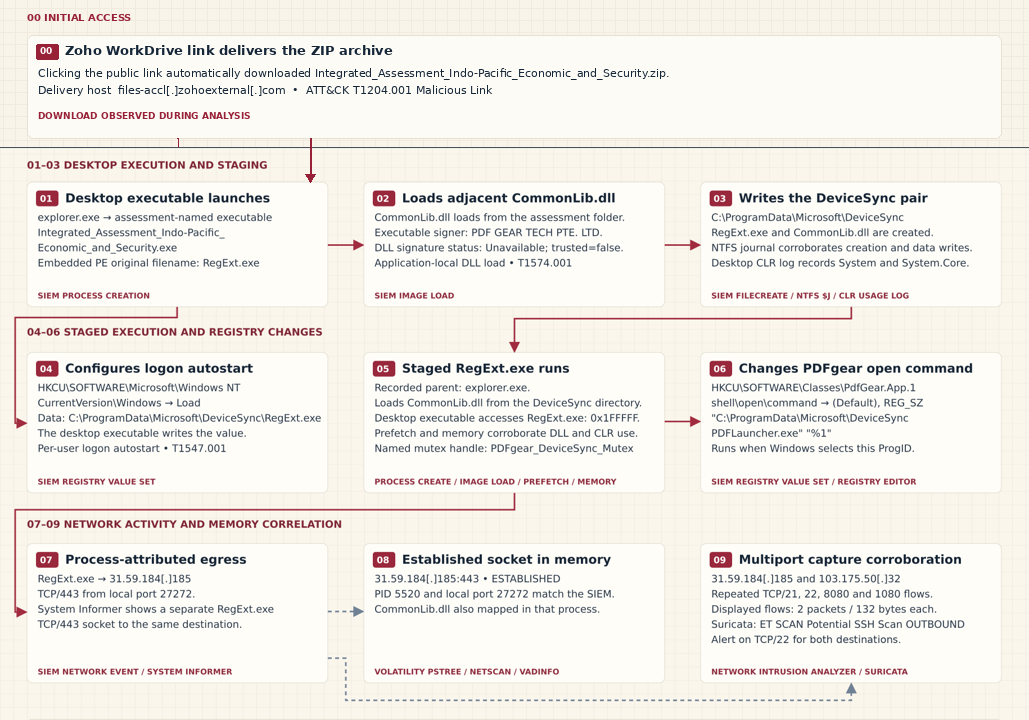
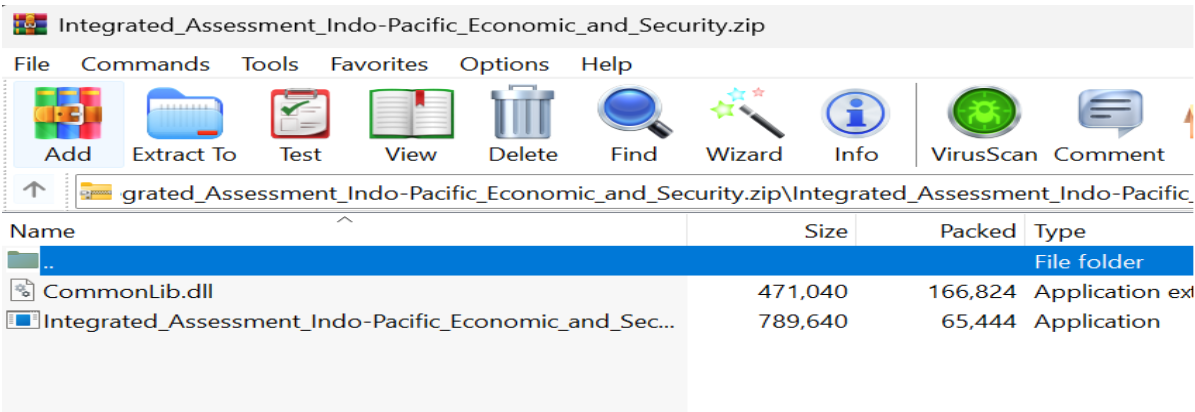
The Malware intrusion chain began with a public Zoho WorkDrive download link (hxxps://files-accl[.]zohoexternal[.]com/public/workdrive-external/download/sa40h523fa72200f642ec9175750b71cae0db?x-cli-msg=n). During analysis, a single click immediately downloaded Integrated_Assessment_Indo-Pacific_Economic_and_Security.zip. The archive carried an executable with the same assessment-themed name alongside CommonLib.dll, placing the two files together for the DLL side-loading observed later in the chain.
Execution
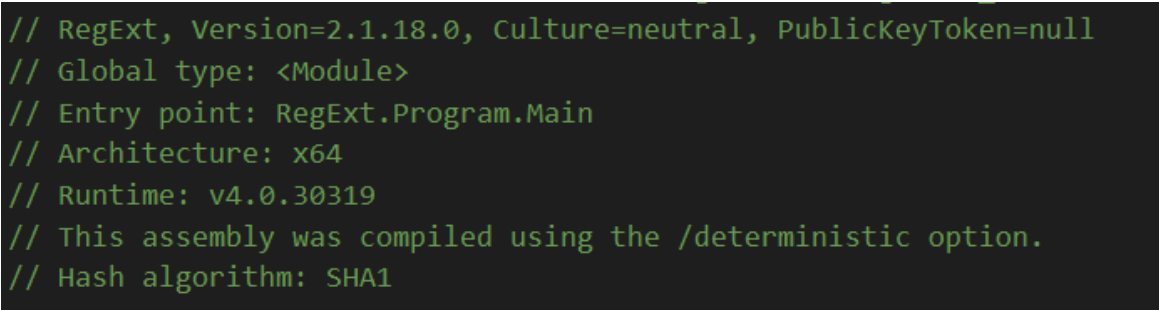
Integrated_Assessment_Indo-Pacific_Economic_and_Security.exe is a .NET executable containing the RegExt assembly (version 2.1.18.0), with RegExt.Program.Main() as its entry point.
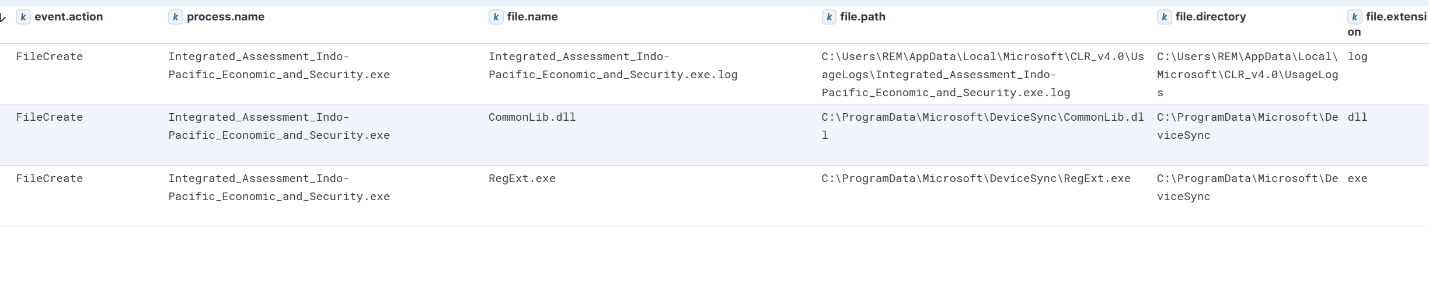
The executable creates a staging directory at C:\ProgramData\Microsoft\DeviceSync and drops RegExt.exe and CommonLib.dll into the directory. Both files are subsequently associated with the execution chain originating from the assessment-themed executable.
DLL Side Loading
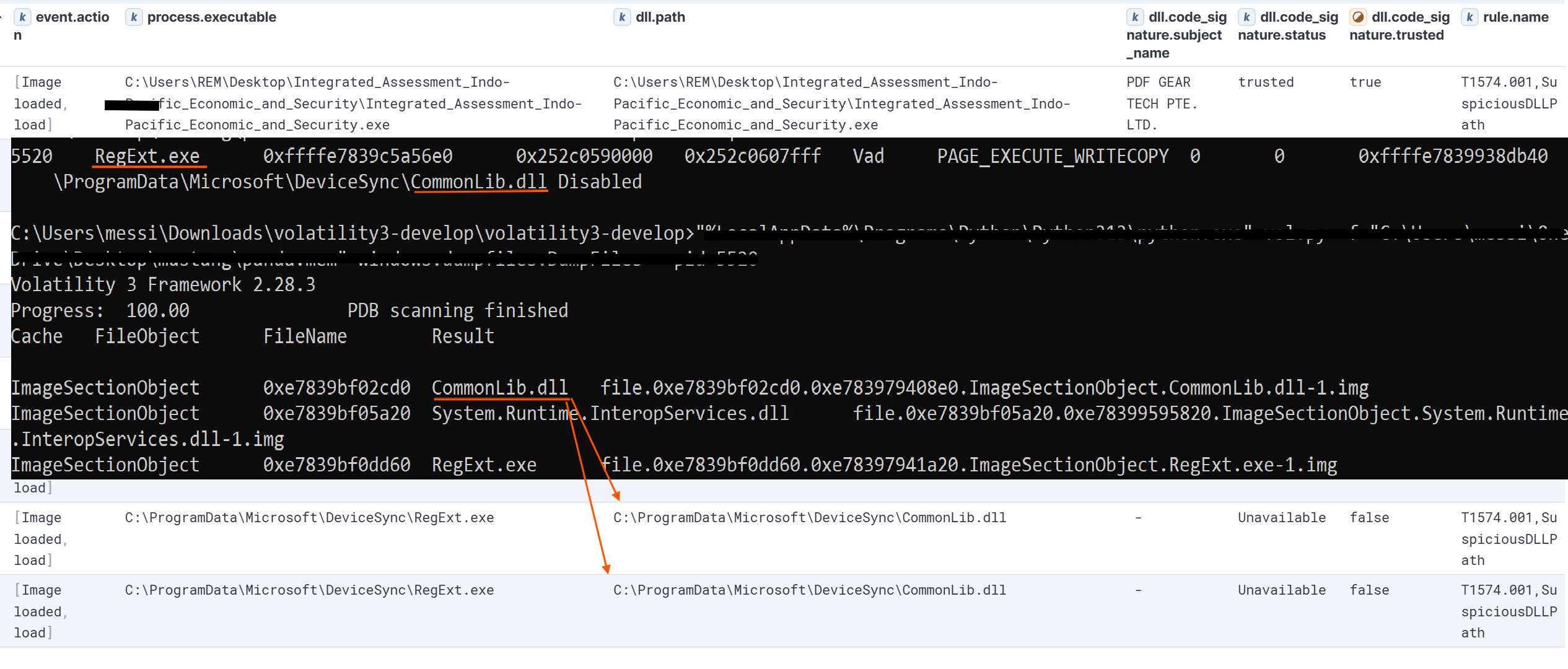
RegExt.exe, a trusted PDFgear executable, loaded CommonLib.dll from C:\ProgramData\Microsoft\DeviceSync, leveraging DLL side-loading to execute the malicious library.
Persistence Mechanism
The malware implements two logon autostart mechanisms and a PDFgear file-association hijack to maintain execution through Windows registry modifications.
Run Key Autostart
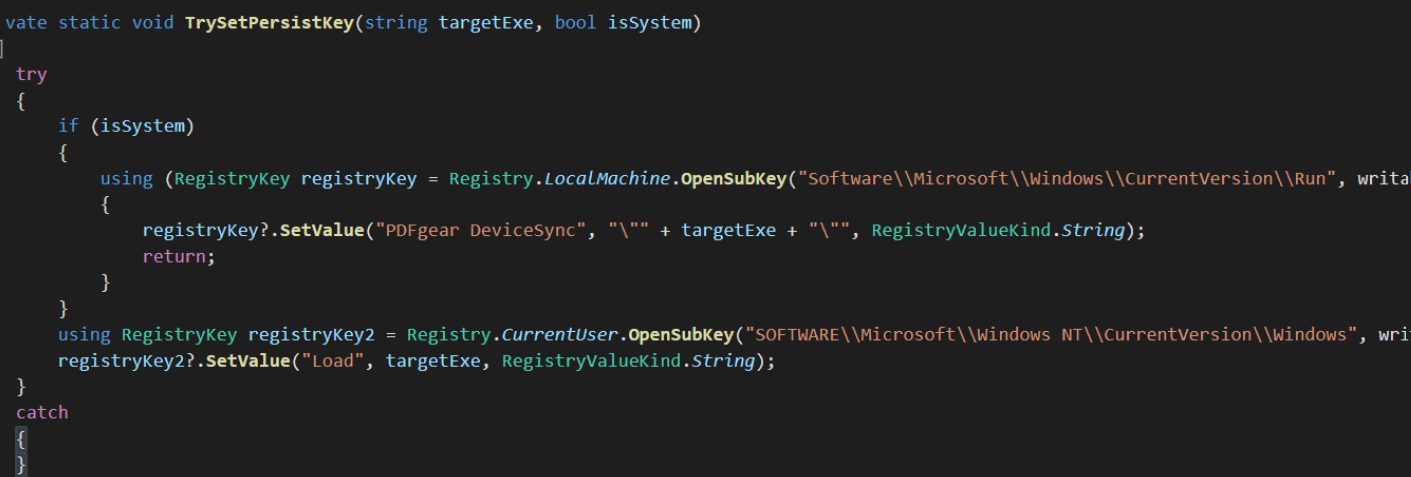
TrySetPersistKey implements conditional persistence based on the execution context. When isSystem is true, the program writes the target executable to the system-wide Run key. Otherwise, it configures the current user's Windows\Load value.
Persistence via PDF File Association Hijacking
RegExt.exe modifies the PdfGear.App.1 ProgID open command, redirecting PDFgear-associated file operations to PDFLauncher.exe under the DeviceSync directory. The %1 parameter forwards the selected file path to the launcher as outlined below.

Mutex Artifacts
Memory forensics of the staged RegExt.exe process associated with Malware revealed an active named Windows Mutant (PDFgear_DeviceSync_Mutex). The naming convention of this synchronization object mirrors the masqueraded PDFgear and DeviceSync themes utilized across the broader execution chain, serving as a high-confidence host-based indicator for detection and incident scoping.

Command and Control Configuration
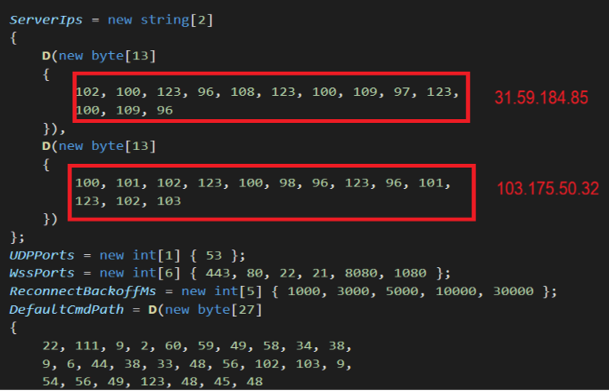
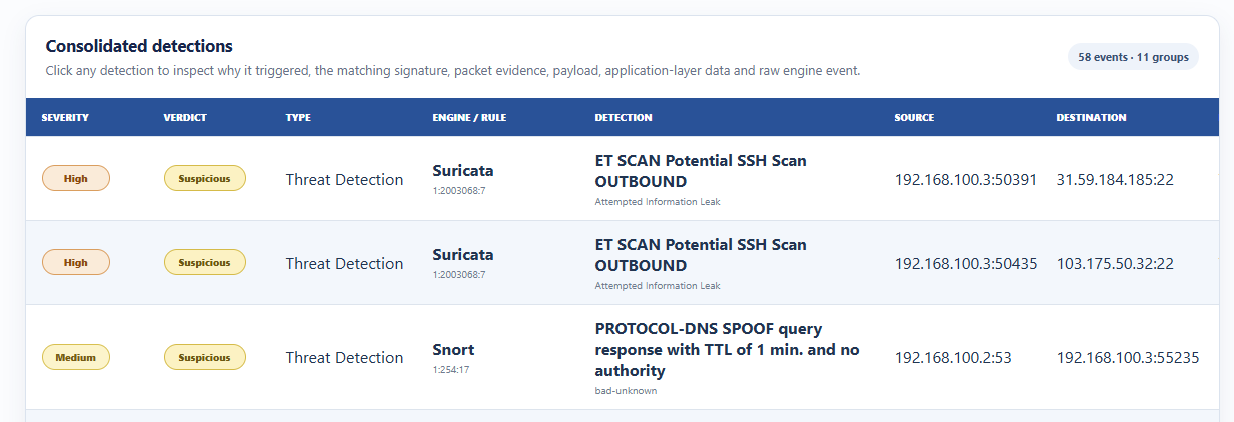
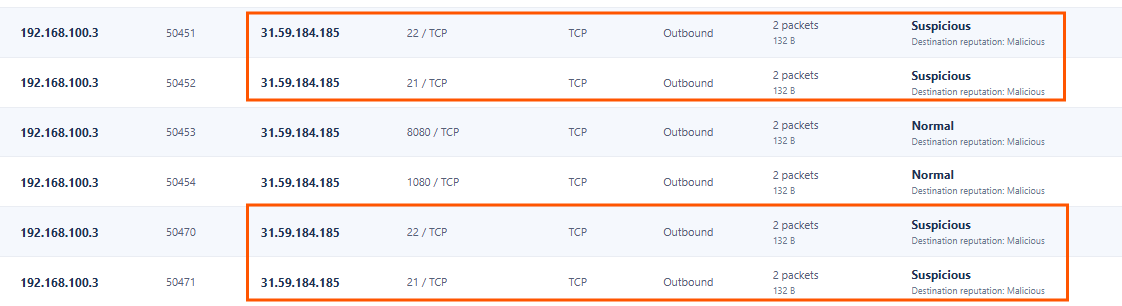
C2 configuration as XOR-encoded byte arrays that are decoded at runtime with a single-byte key (0x55). It contains two hardcoded C2 IP addresses, 31[.]59[.]184[.]185 and 103[.]175[.]50[.]32, which suggests a primary and a backup server. The client is configured to communicate over UDP port 53 and over WSS on ports 443, 80, 22, 21, 8080 and 1080, and it retries failed connections with a progressive backoff of 1, 3, 5, 10 and 30 seconds.
The C2 traffic, as observed in Network Intrusion Analyzer, is illustrated in the figure below.
C2 Protocol Magic Value
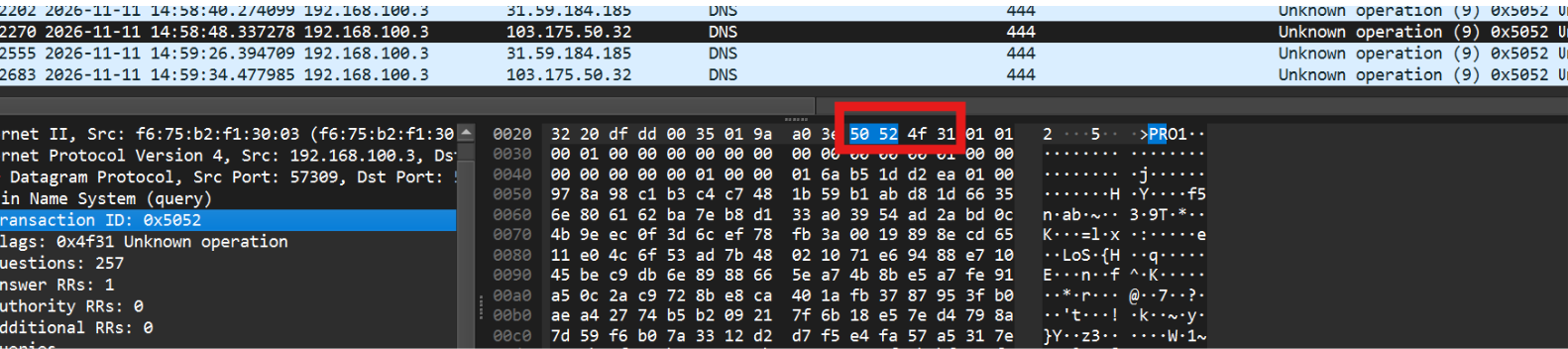
Malware uses a modified protocol magic value, 0x50524F31, replacing the previously documented LOTUSLITE identifiers 0x8899AABB and 0xB2EBCFDF. The hardcoded value is defined in ProtocolConst.Magic and serves as the packet signature identifying Malware C2 communications. This change renders network detection rules relying on the earlier magic values ineffective against traffic using the updated identifier.
Bypassing High-Level Runtime Abstractions
Previously Documented Legacy C++ LOTUSLITE: Evolved from raw memmove packet assembly to dynamically resolving memcpy from ntdll.dll via the LdrLoadDll native API chain, avoiding static IAT imports and bypassing higher-level Win32 hooks.
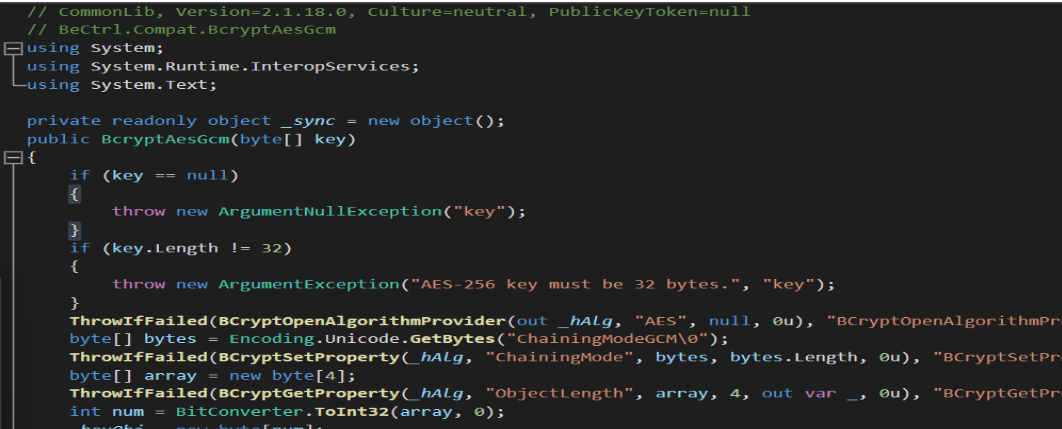
Analyzed C# Variant (CommonLib / BeCtrl): Replaces raw memory routines with memory-safe Span<byte> primitives (ProtoHeader) and uses P/Invoke (BeCtrl.Compat.BcryptAesGcm) to invoke native bcrypt.dll directly bypassing .NET's high-level AesGcm wrapper to ensure AES-256-GCM compatibility on older Windows endpoints.
Comparative Technical Lineage:
| Dimension | Legacy Lotuslite (C++) | Lotuslite V2 / Successor (C# Sample) | Why This Proves Evolution / Lineage |
|---|---|---|---|
| Magic Header Convention | 0x8899AABB (v1.0) -> 0xB2EBCFDF (v1.1) | 0x50524F31 (PRO1) | Transitions from rotating raw 4-byte hex magic constants (0x8899AABB / 0xB2EBCFDF) to a formal, human-readable ASCII protocol tag (PRO1) with a dedicated version byte |
| Programming Language & Architecture | Native C++ monolithic or modular DLL | Managed .NET / C# (CommonLib v2.1.18.0) | Full port to C# while retaining identical wire-framing habits, indicating active developer modernization rather than a new threat actor. |
| Cryptographic Implementation | Transmitted raw binary frames (Magic + Cmd + Len + Payload) protected solely by transport-layer HTTPS (TLS/SSL) via winhttp.dll. | Application-layer AES-256-GCM (AesGcmCodec enforcing a 32-byte key). | Prevents passive traffic decryption even if corporate TLS inspection intercepts the HTTPS session. |
| Directionality & Command Routing | Separate command IDs for check-in vs. tasking | Bitwise MSB masking (MsgType & 0x80) splitting IsB2C (1–126) and IsC2B (129–254) | Standardizes beacon-to-controller (B2C) and controller-to-beacon (C2B) traffic into a clean, extensible namespace. |
| Execution & Persistence TTPs | Signed third-party binary DLL sideloading + %ProgramData% staging + HKCU\...\Run | Signed PDFGear.exe sideloading malicious DLL + %ProgramData% staging + Registry Run key | Identical host-side operational tradecraft used across Mustang Panda (Earth Preta) intrusion sets |
| Victimology & Targeting | Government, diplomatic, and strategic entities in ASEAN / South Asia | Targeted campaign in Thailand (ASEAN) | Aligns directly with Mustang Panda's primary regional espionage priorities. |
| Target Environment Compatibility | Dynamic LdrLoadDll resolution of winhttp.dll | Custom BeCtrl.Compat.BcryptAesGcm P/Invoke wrapper over bcrypt.dll | Specifically engineered to support legacy .NET Framework 4.x hosts common in ASEAN government networks. |
Assessment & Attribution
Based on overlapping operational tradecraft, wire-protocol design habits, and regional victimology, we assess with high confidence that the analyzed C# implant represents a modernized successor or next-generation variant (v2) of the LOTUSLITE malware family, attributed to the China-nexus threat actor Mustang Panda (Earth Preta). While legacy LOTUSLITE builds were natively compiled in C++ and relied on HTTPS transport to protect raw binary frames, this .NET port (CommonLib v2.1.18.0, internal namespace BeCtrl) introduces a formalized, versioned binary protocol (PRO1 / 0x50524F31) protected by application-layer AES-256-GCM encryption.
Appendix
Indicators of Compromise
| Type | Indicator | Evidence |
|---|---|---|
| Network | 31.59.184[.]185 | Process-attributed TCP/443 and UDP/53 activity. |
| Network | 103.175.50[.]32 | Repeated multiport traffic in the NIDS capture. |
| File | C:\ProgramData\Microsoft\DeviceSync\RegExt.exe | Staged executable. |
| File | C:\ProgramData\Microsoft\DeviceSync\CommonLib.dll | Application-local DLL. |
| Mutex | PDFgear_DeviceSync_Mutex | Named handle recovered from process memory. |
Archive
d74fee10090cae17655d137e060398ce6fe52eb811ebc67a439ef37297e5014f
Assessment executable and staged RegExt.exe
33cf56f15b9e069e3f21d23338ec96c2aaf6edd4f2baadcea2af39e1968515ea
CommonLib.dll
4748571d98c6af34f4967a3886f73b4421239a1203f048140d3bfdaf8aa78937
Detection Queries
Registry persistence via DeviceSync — Windows Load value
KQLDeviceRegistryEvents
| where RegistryKey contains "\\SOFTWARE\\Microsoft\\Windows NT\\CurrentVersion\\Windows" and RegistryKey endswith "\\Load" and RegistryValueData contains "\\Microsoft\\DeviceSync\\RegExt.exe"Registry persistence via DeviceSync — Run key
KQLDeviceRegistryEvents
| where RegistryKey contains @"\Microsoft\Windows\CurrentVersion\Run" and RegistryValueName contains " PDFgear DeviceSync"PDFgear ProgID Open Command Hijack to DeviceSync Directory
KQLDeviceRegistryEvents
| where (RegistryKey contains "PdfGear.App" and RegistryKey contains "\\shell\\open\\command") and RegistryValueData contains "\\DeviceSync\\PDFLauncher.exe"RegExt.exe Outbound Network Connection from DeviceSync Directory
KQLDeviceNetworkEvents
| where InitiatingProcessFolderPath contains "\\ProgramData\\Microsoft\\DeviceSync\\" and InitiatingProcessFolderPath endswith "\\RegExt.exe"Zoho WorkDrive External File Download URL Access
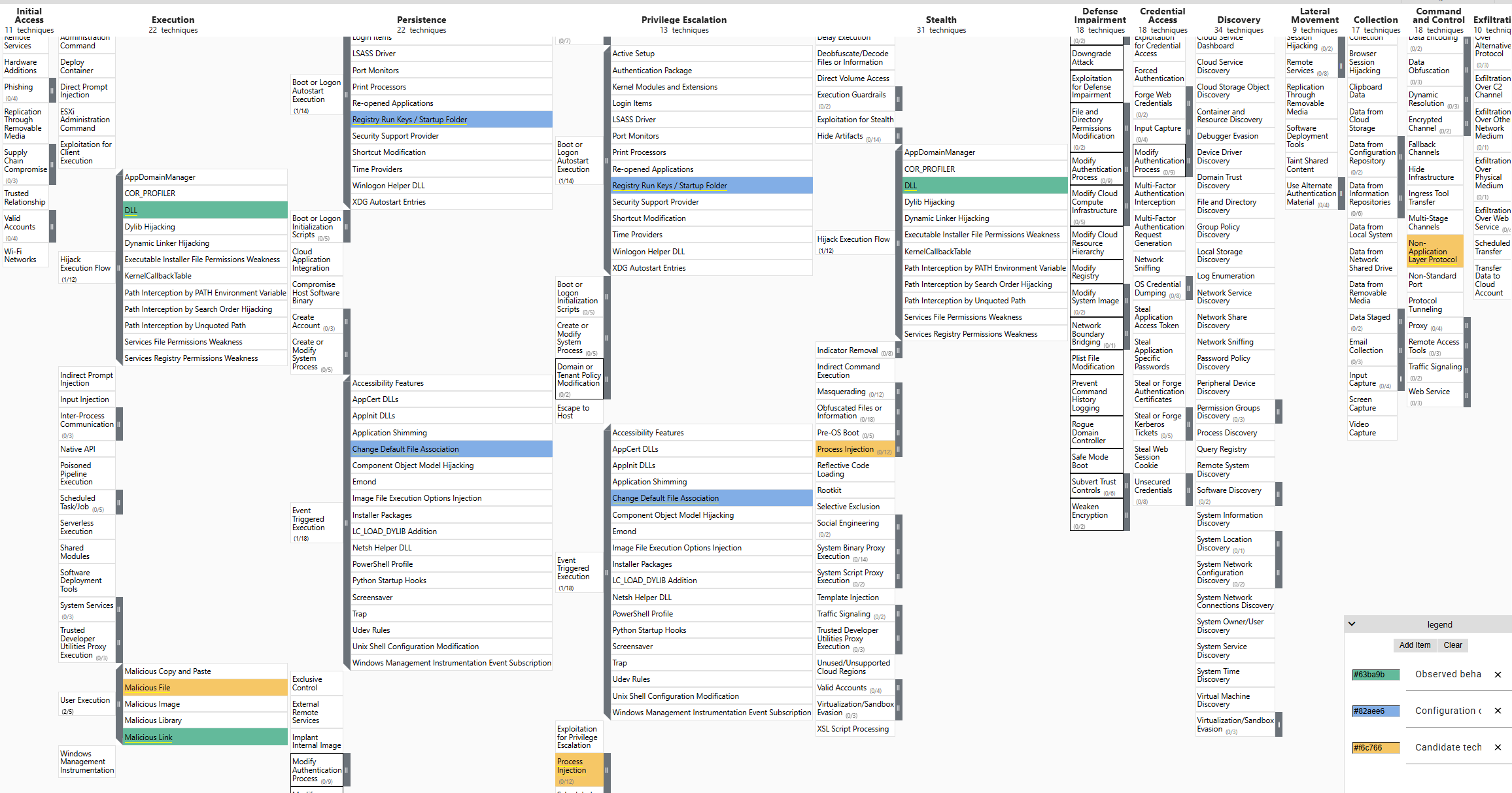
Splunk"cs-host"="*zohoexternal.com*" "cs-uri-stem"="*/public/workdrive-external/download/*"MITRE ATT&CK MAPPING
Disclaimer: This research was performed independently and in our personal capacity. It does not represent the views of employer, past or present, or of any affiliated organization, and no confidential or proprietary information from any employer was used. The findings are provided for informational and defensive purposes only, “as is”, without warranty. Some conclusions are based on static analysis and may be revised as more information becomes available.
Written by Kyaw Pyiyt Htet (Mikoyan) & PHYO PAING HTUN (ChiLai)