Canon Under Fire: UNC6384's Multi-Stage PlugX Campaign Through Trusted Software
Analysis Classification: TLP:WHITE
Type: Advanced Persistent Threat (APT) - PRC-nexus threat actor UNC6384
Sample: 62b2a9.msi (MSI Package Dropper)
Malware Family: PlugX/Korplug (CANONSTAGER variant)
Executive Summary
This report provides an in-depth examination of a UNC6384 campaign utilizing MSI package abuse combined with DLL side-loading techniques. The campaign demonstrates sophisticated understanding of Windows internals and employs multiple redundancy mechanisms to ensure persistent access while evading detection.
The attack chain leverages Windows Installer functionality for initial deployment. It abuses legitimate Canon printer software for DLL side-loading. Registry-based persistence uses deceptive naming conventions. Multiple anti-forensic techniques include time stomping and self-replication across diverse file system locations.
Key Findings
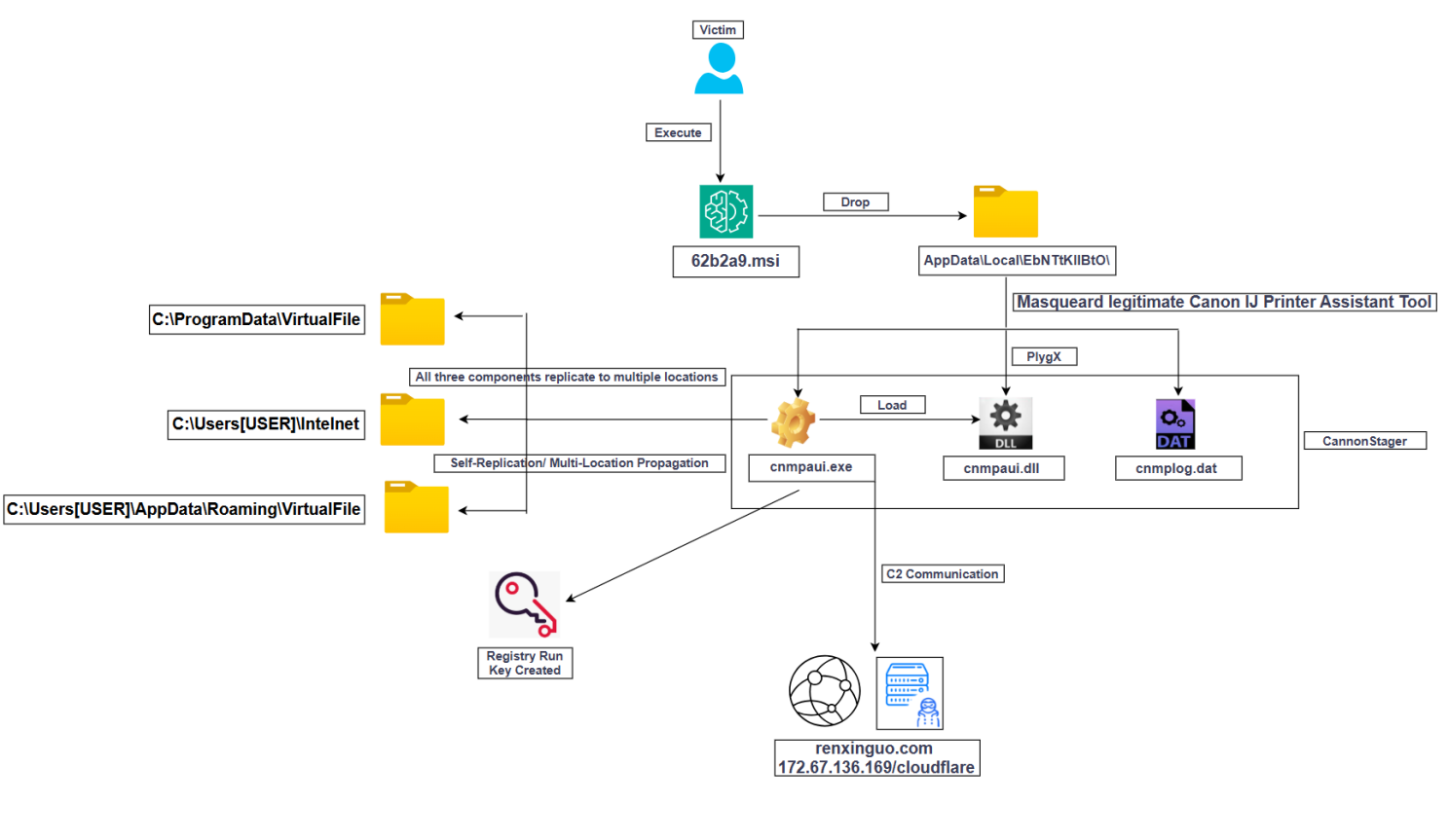
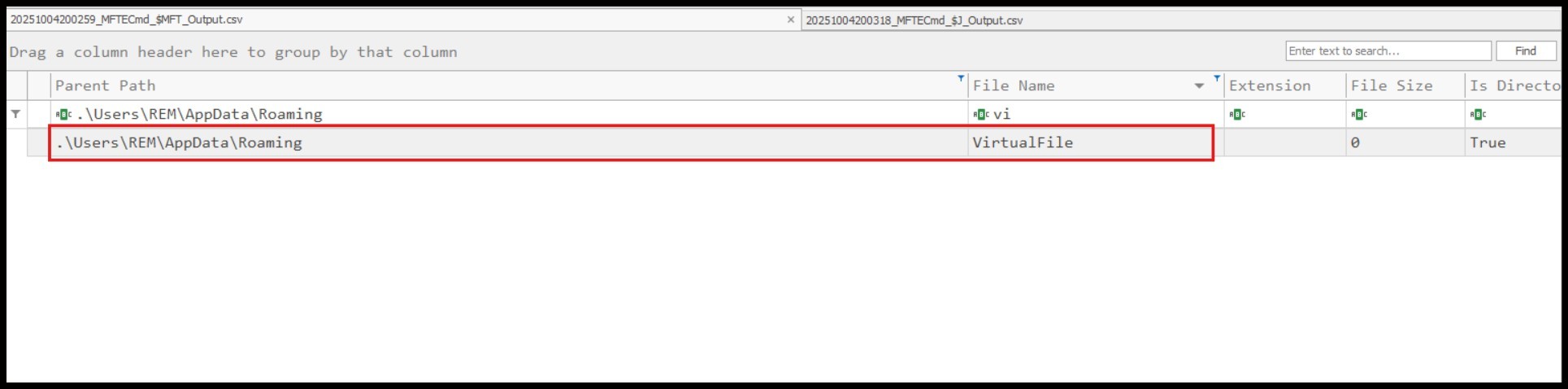
Self-Replication : The malware copies itself to multiple locations using dynamic directory names. Observed paths include randomized AppData folders, VirtualFile directories, and system-wide ProgramData locations. This provides operational redundancy and complicates removal efforts.
Timestomping : File creation timestamps are backdated to 2025/03. This makes new files appear as pre-existing components. Timeline-based threat hunting is evaded. Sysmon captured both fraudulent and authentic timestamps.
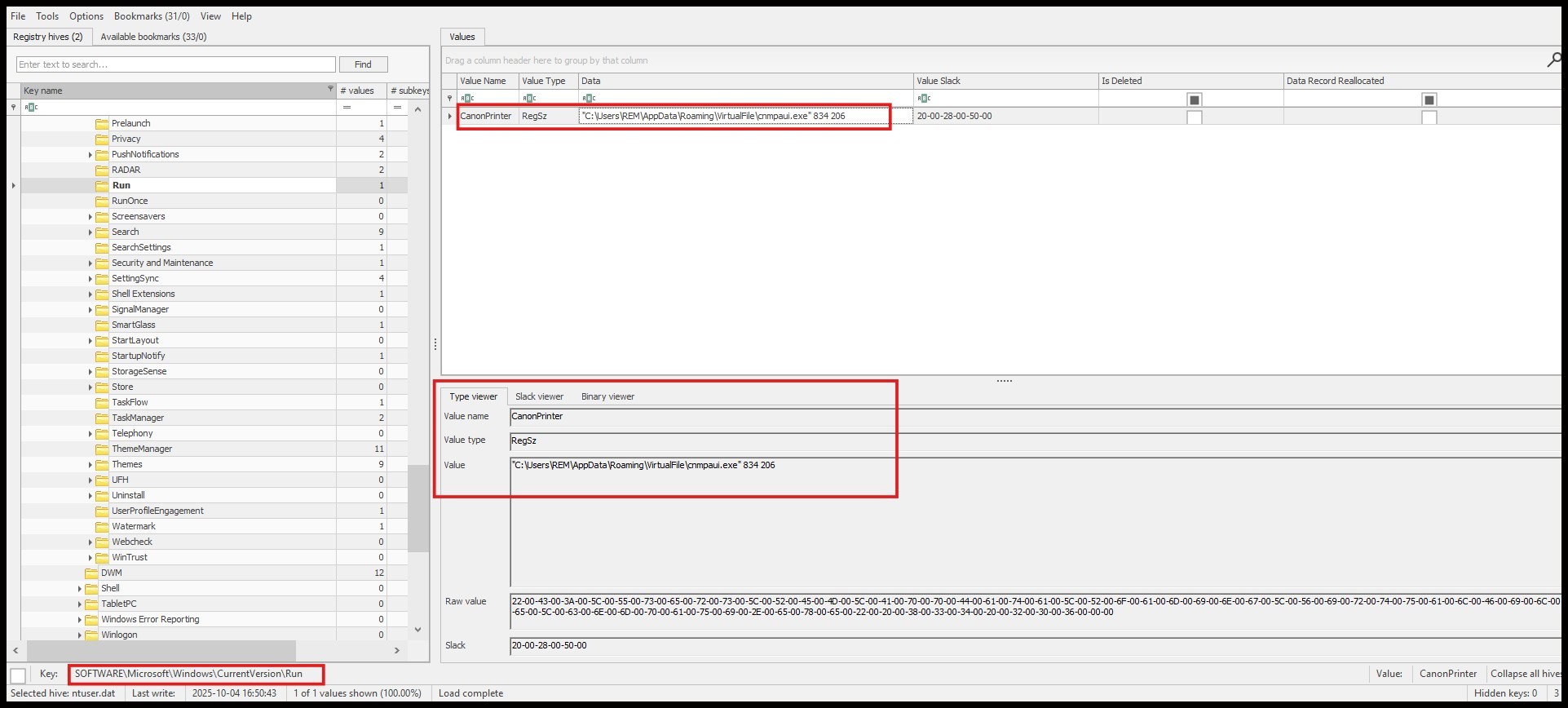
Persistence Mechanism : A registry Run key named "CanonPrinter" ensures automatic execution at logon. The naming exploits user familiarity with Canon software. Multiple instances point to different file locations for redundancy.
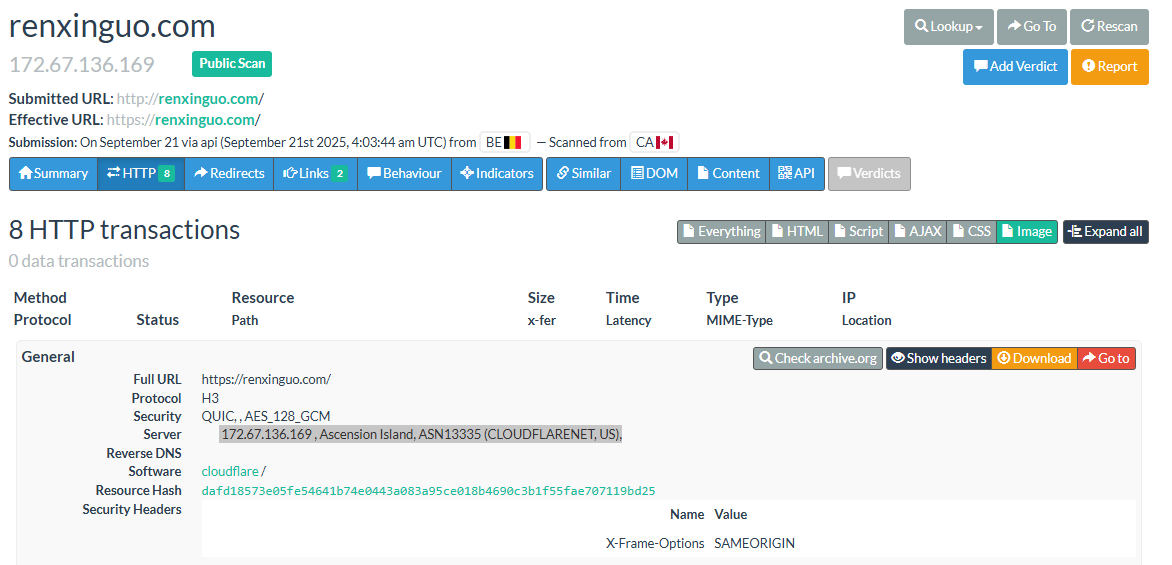
Network Infrastructure : DNS queries target renxinguo.com, flagged by nine security vendors. Associated IP 172.67.136.169 belongs to ASN 13335 Cloudflare infrastructure.
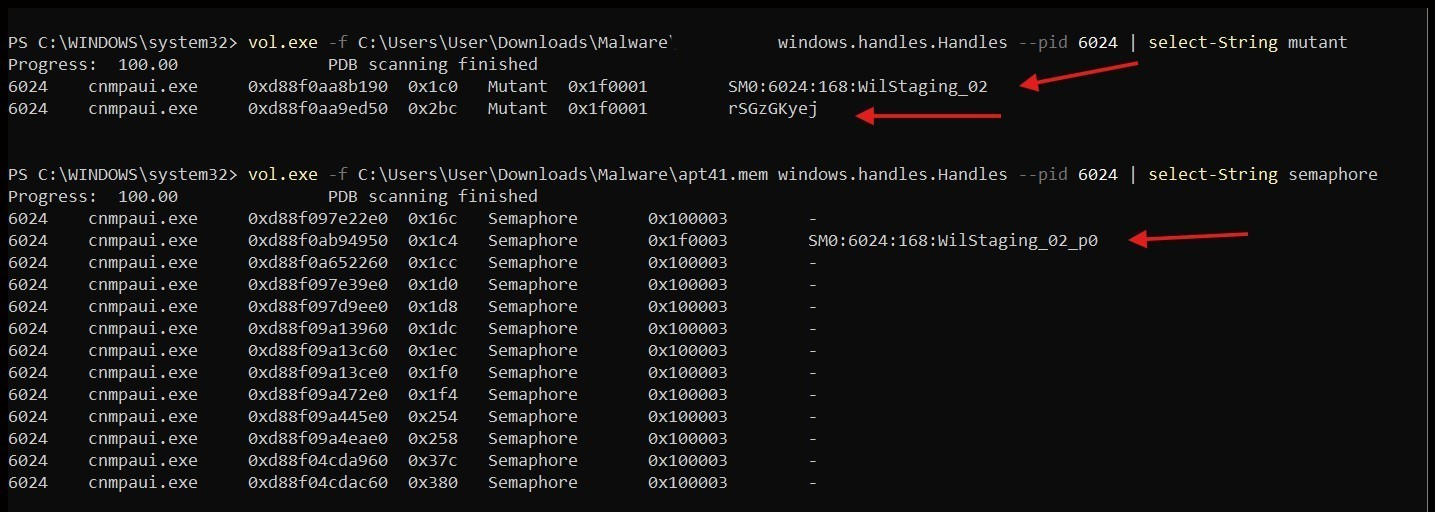
In-Memory Execution : The RC4-encrypted payload deploys directly into memory without touching disk. A custom mutex "rSGzGKyej" enforces single-instance operation. Process injection indicators confirmed malicious memory manipulation.
Attack Chain
Technical Details
Initial Access and MSI Execution Analysis
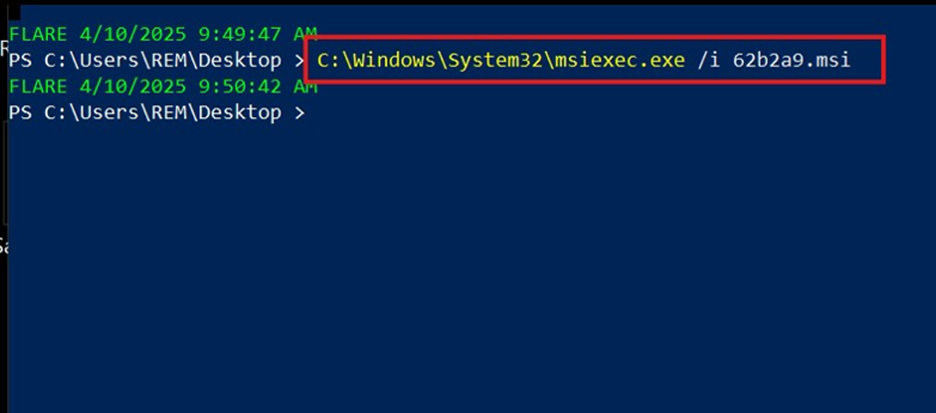
MSI Package Execution : The MSI file 62b2a9.msi contains embedded malicious components disguised as Canon printer software.

File System Operations and Deployment
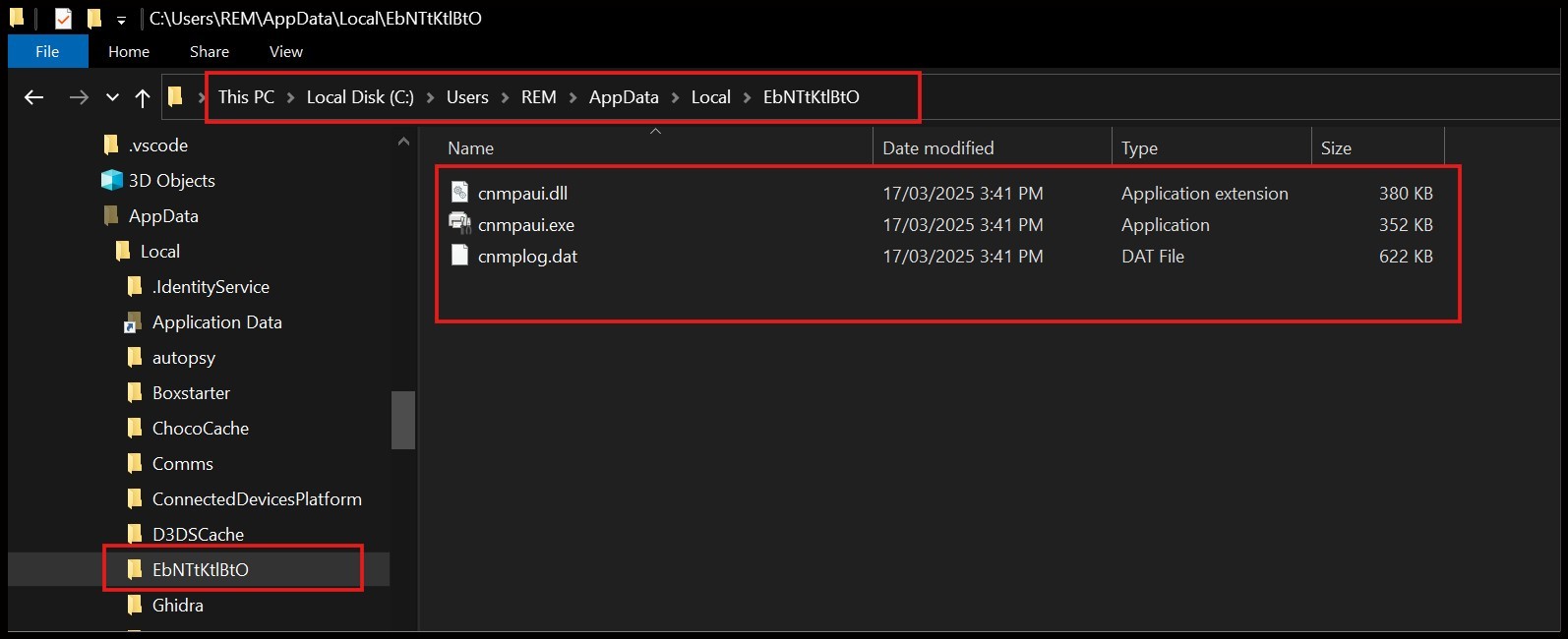
Primary Installation Location
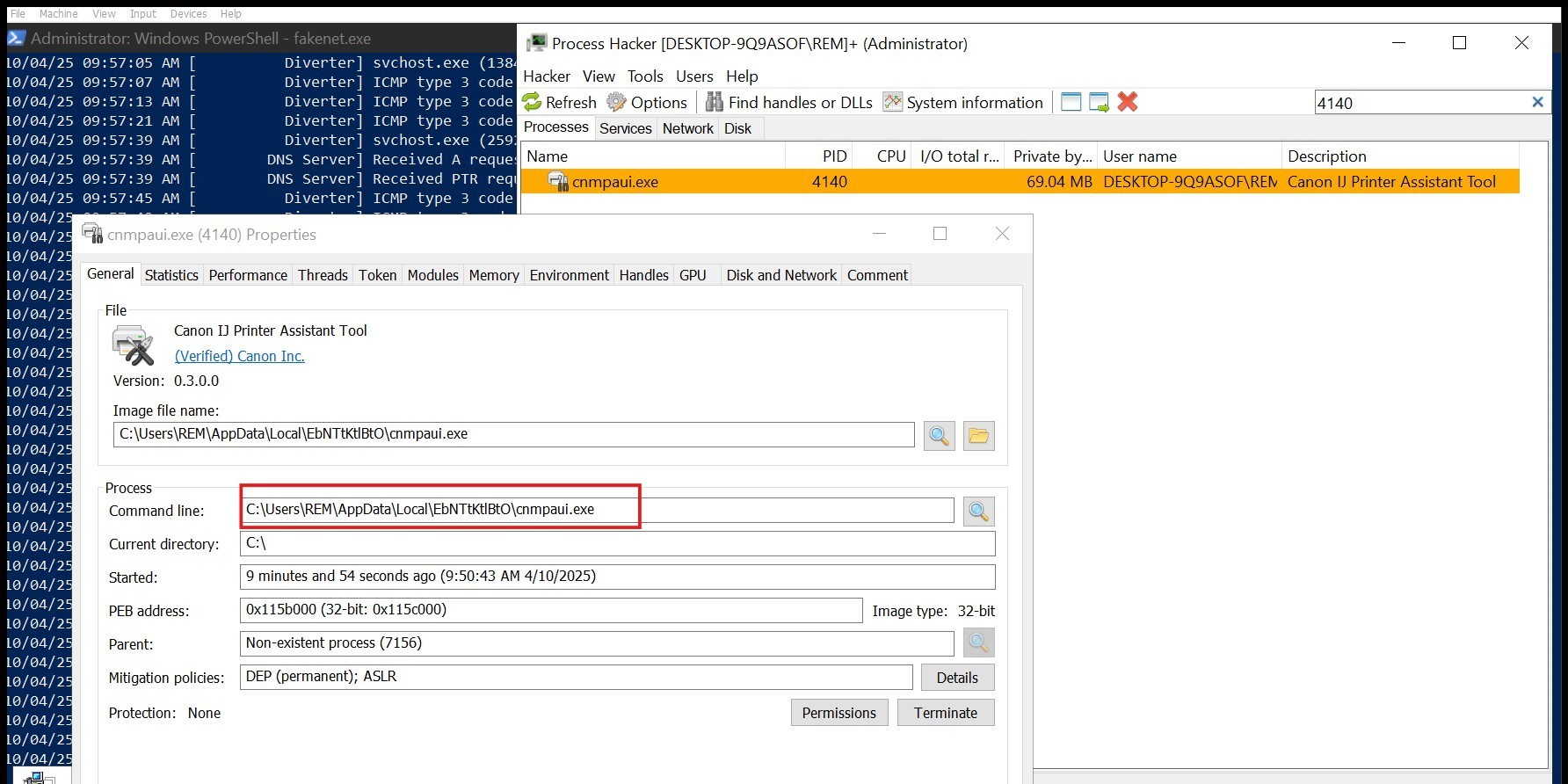
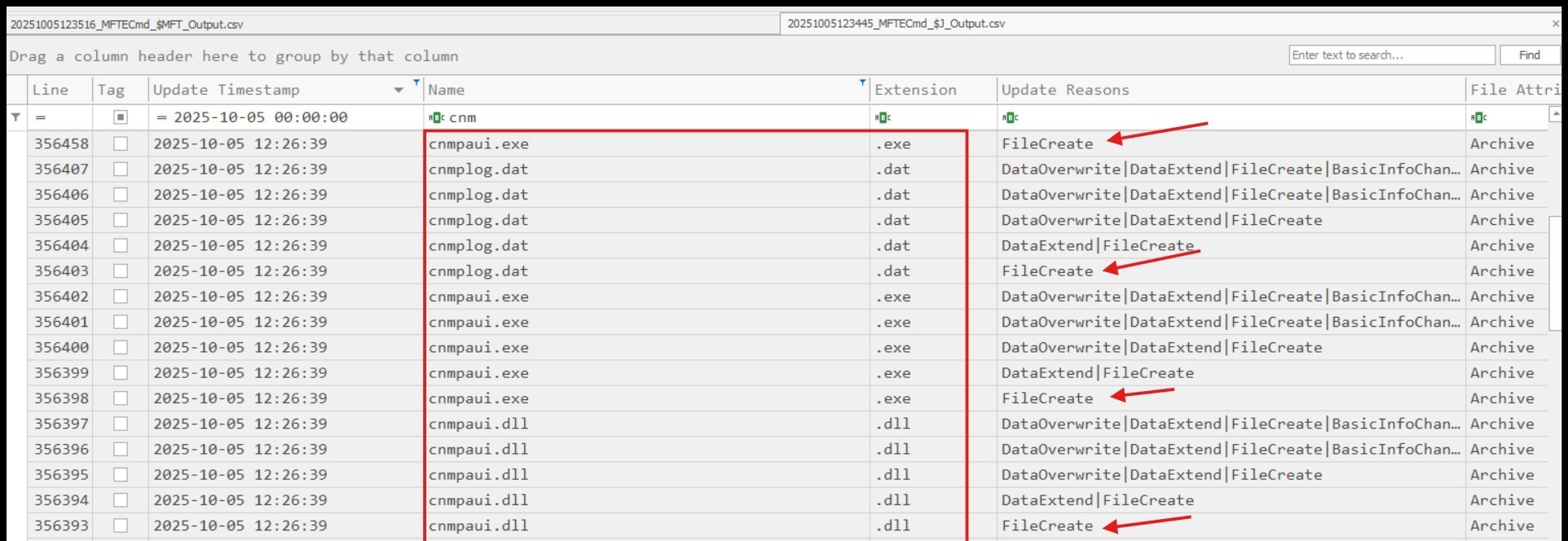
The MSI dropped three files into AppData\Local\EbNTtKIlBtO, a directory whose randomized alphanumeric name is likely intended to evade pattern-based detection and blend with legitimate application folders. Static and dynamic analysis indicate the installer delivers three components such as cnmplog.dat, cnmpaui.dll, and cnmpaui.exe, where cnmpaui.exe is a legitimately signed Canon binary likely abused to impart trust and enable execution, cnmpaui.dll acts as a malicious PlugX DLL, and cnmplog.dat contains an encrypted payload that is staged and executed in memory.
Analysis of PlugX dll
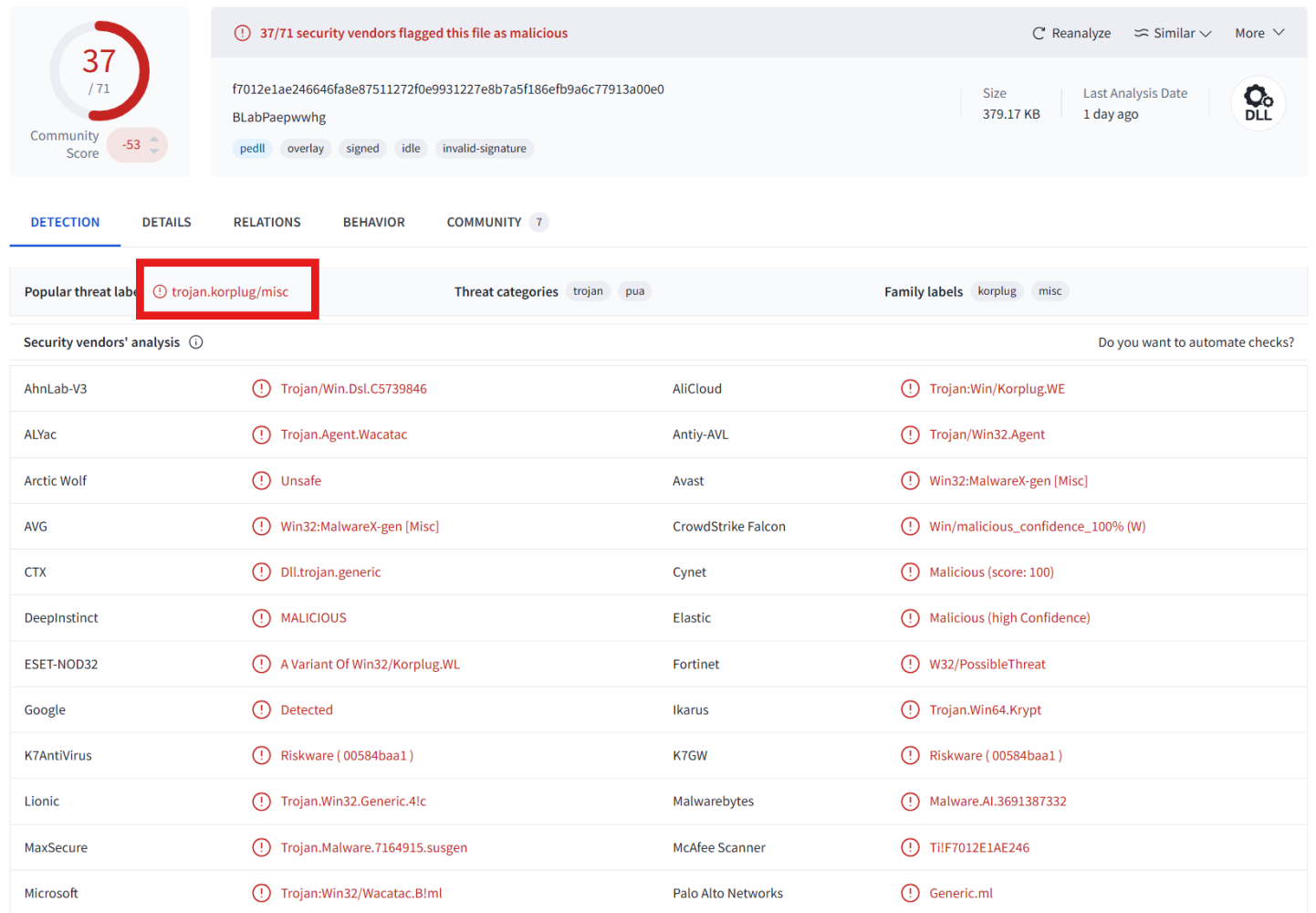
cnmpaui.dll This contains the PlugX/Korplug loader code (CANONSTAGER). The DLL lacks any digital signature and would fail validation checks. However, Windows doesn't enforce signature requirements on loaded DLLs by default. Multiple security vendors identify this as Trojan.Korplug.
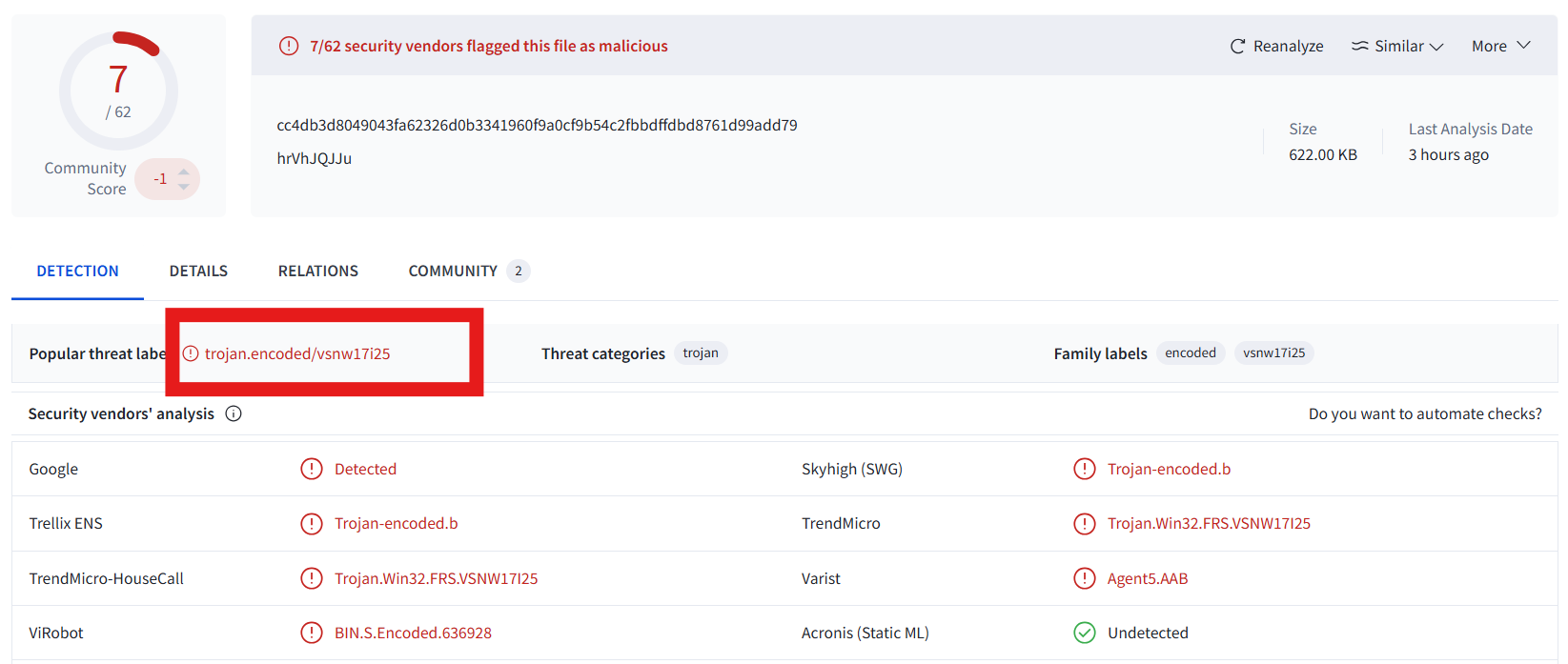
cnmplog.dat : This file contains the RC4-encrypted final-stage payload.
Self-Replication and Multi-Location Propagation
Propagation Behavior
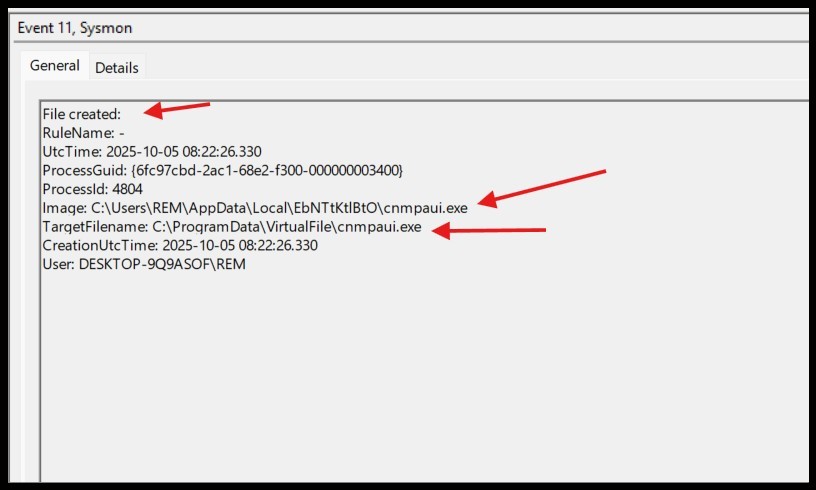
After initial infection, cnmpaui.exe executes file copy operations. All three components replicate to multiple locations. This creates redundant infection chains across the file system.
First Propagation - ProgramData
Target: C:\ProgramData\VirtualFile\ Copied: cnmpaui.exe, cnmpaui.dll, cnmplog.dat
Second Propagation - User Profile
Target: C:\Users[USER]\Intelnet\ Copied: cnmpaui.exe, cnmpaui.dll, cnmplog.dat Rationale: Different directory name indicates dynamic path selection
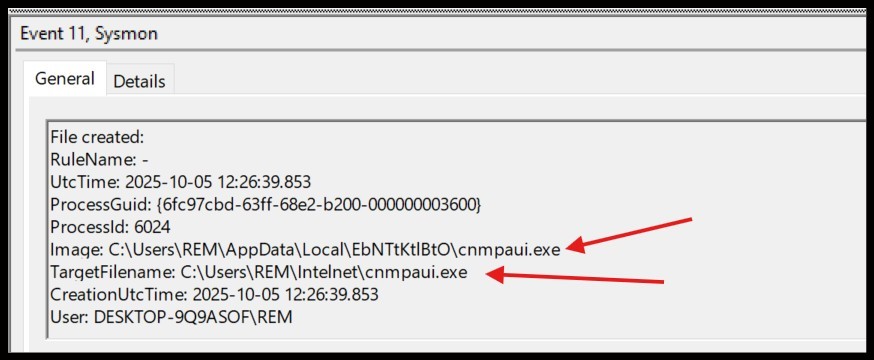
Third Propagation - Roaming Profile
Target: C:\Users[USER]\AppData\Roaming\VirtualFile\ Copied: cnmpaui.exe, cnmpaui.dll, cnmplog.dat
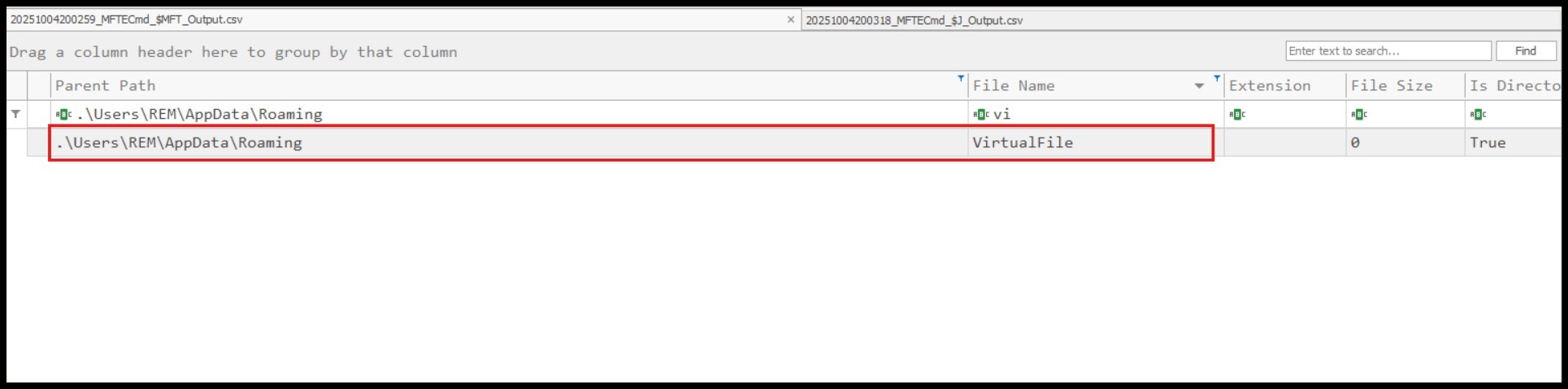
Summary: The malware propagates into multiple directories to ensure redundant persistence, making removal more difficult by maintaining several active copies across the system.
Forensic Evidence of File Timestamp Tampering
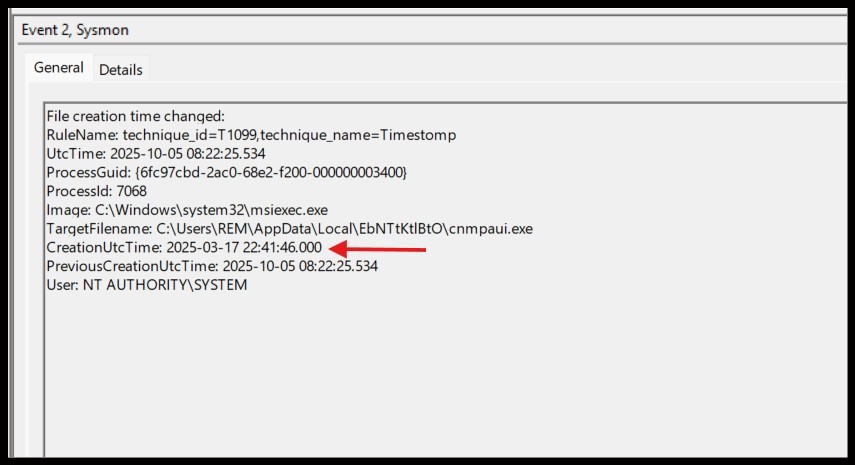
Sysmon Event ID 2 detected a timestamp tampering activity performed by msiexec.exe during installation.
File: cnmpaui.exe
Modified Timestamp: 2025-03-17 22:41:46
Actual Creation Time: 2025-10-05 08:22:25.534
Difference: ~7 months backdated
Sysmon retained both values, with the PreviousCreationUtcTime field serving as forensic evidence of the timestamp manipulation.
DLL Side-Loading Technique
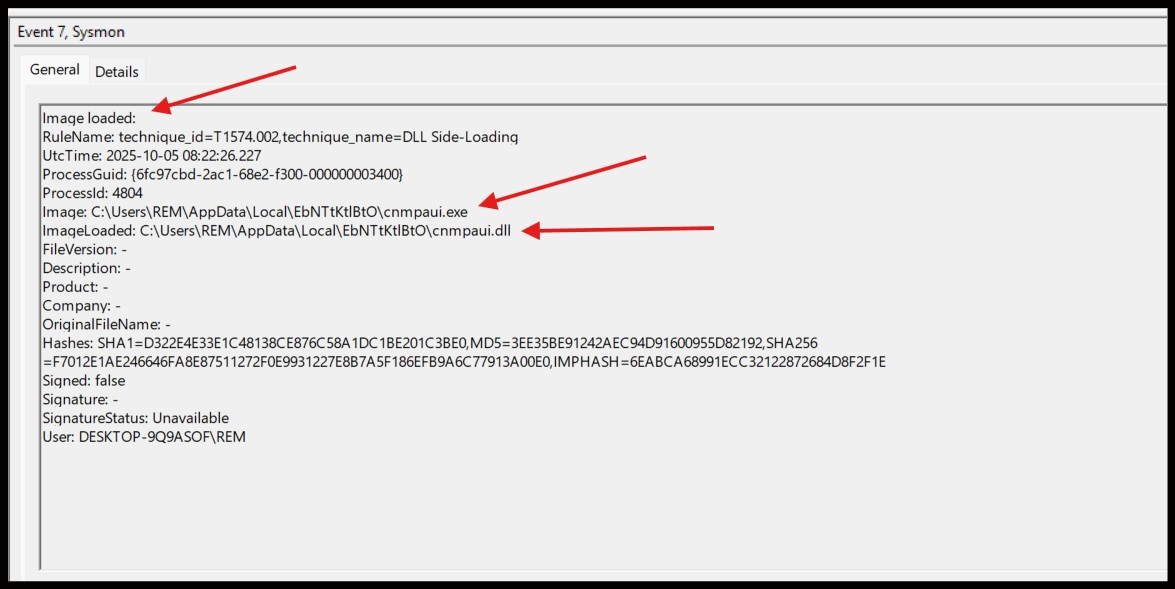
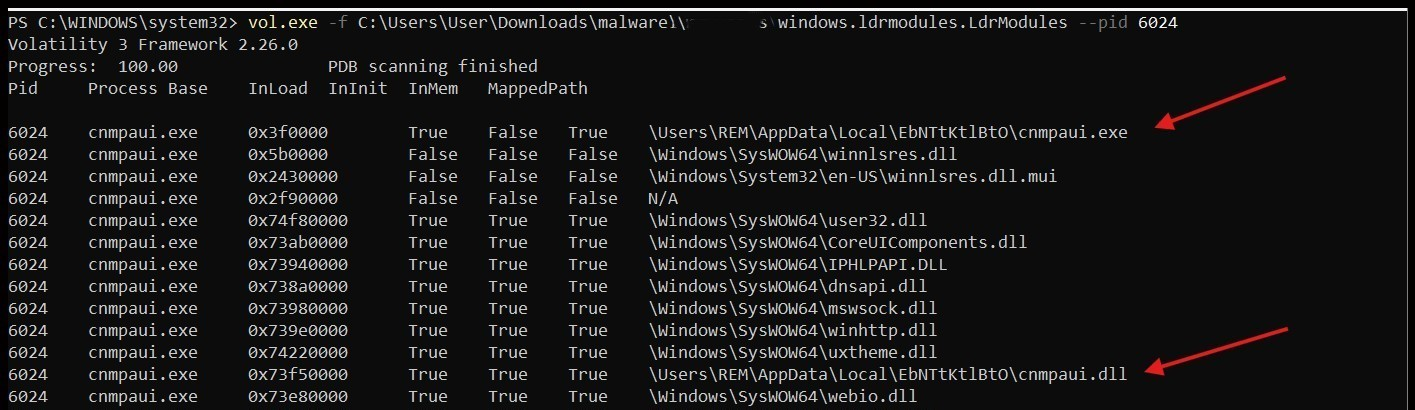
A malicious cnmpaui.dll placed in the same folder was loaded immediately after the legitimate, signed Canon executable (version 1.05.2.20). The signed executable established a trusted context, and the unsigned cnmpaui.dll inherited that trust when loaded.
Persistence Mechanism
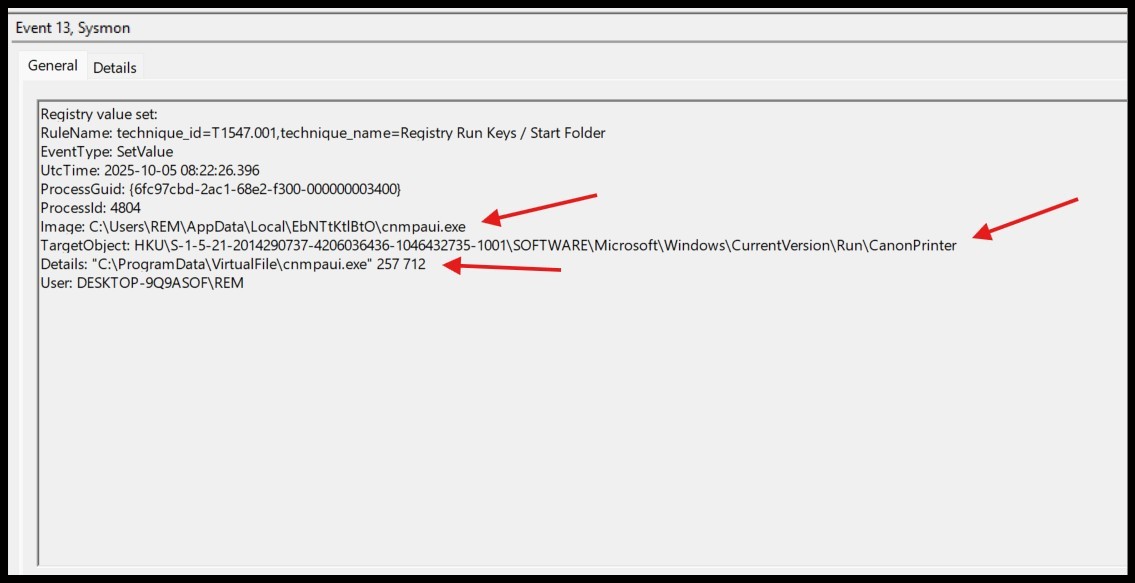
Sysmon Event ID 13 recorded multiple registry value creations under the Run key \SOFTWARE\Microsoft\Windows\CurrentVersion\Run, indicating attempts to establish redundant persistence. The values referenced the same executable placed in different directories:
%AppData%\Roaming\VirtualFile\cnmpaui.exe
%ProgramData%\VirtualFile\cnmpaui.exe
The modifications were performed by the cnmpaui.exe process, demonstrating deliberate replication of persistence entries to ensure execution resilience across reboots.
Network Communications and Command & Control
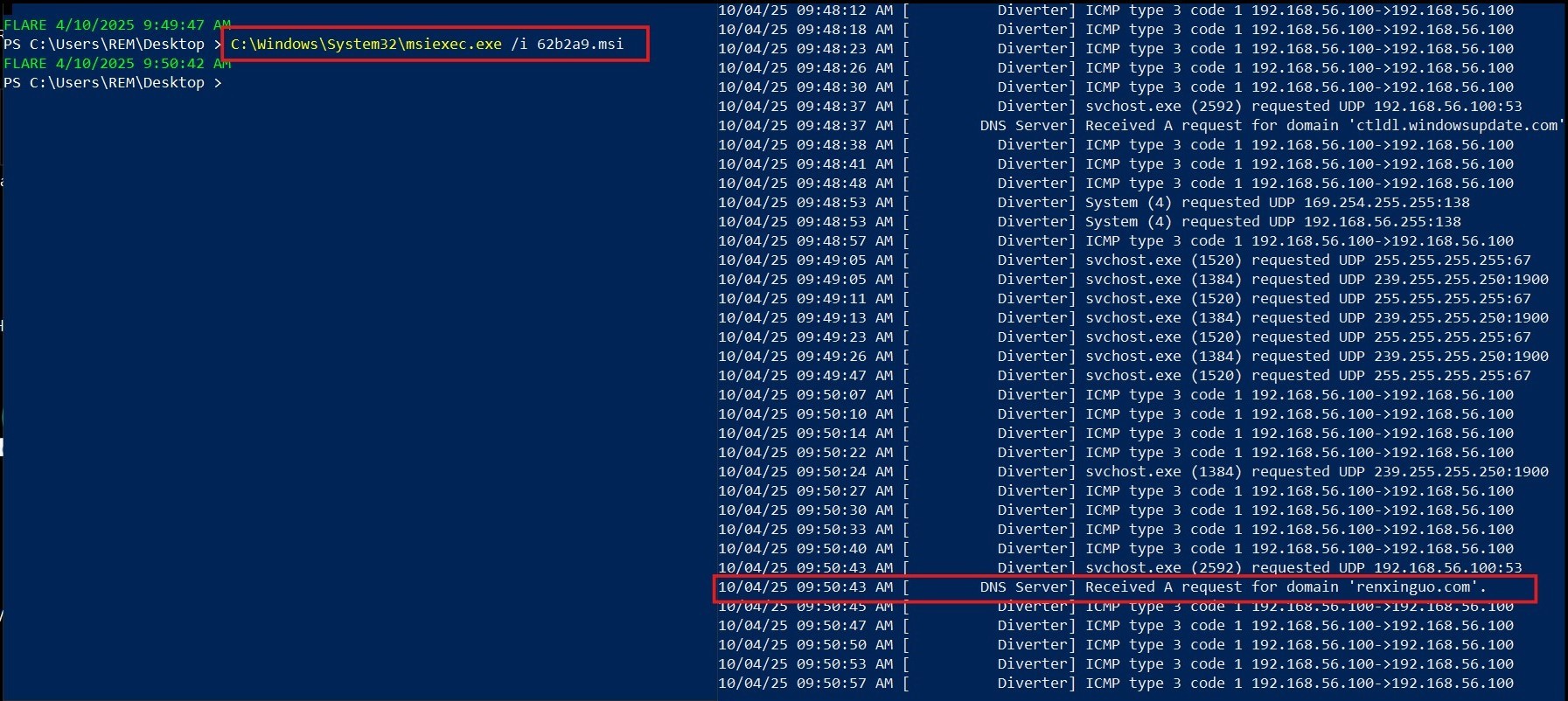
DNS Query Activity
FakeNet confirmed execution of the MSI installer, outbound connections to renxinguo[.]com were observed.
Domain Reputation
VirusTotal reports 9 of 98 vendors flagging as malicious.
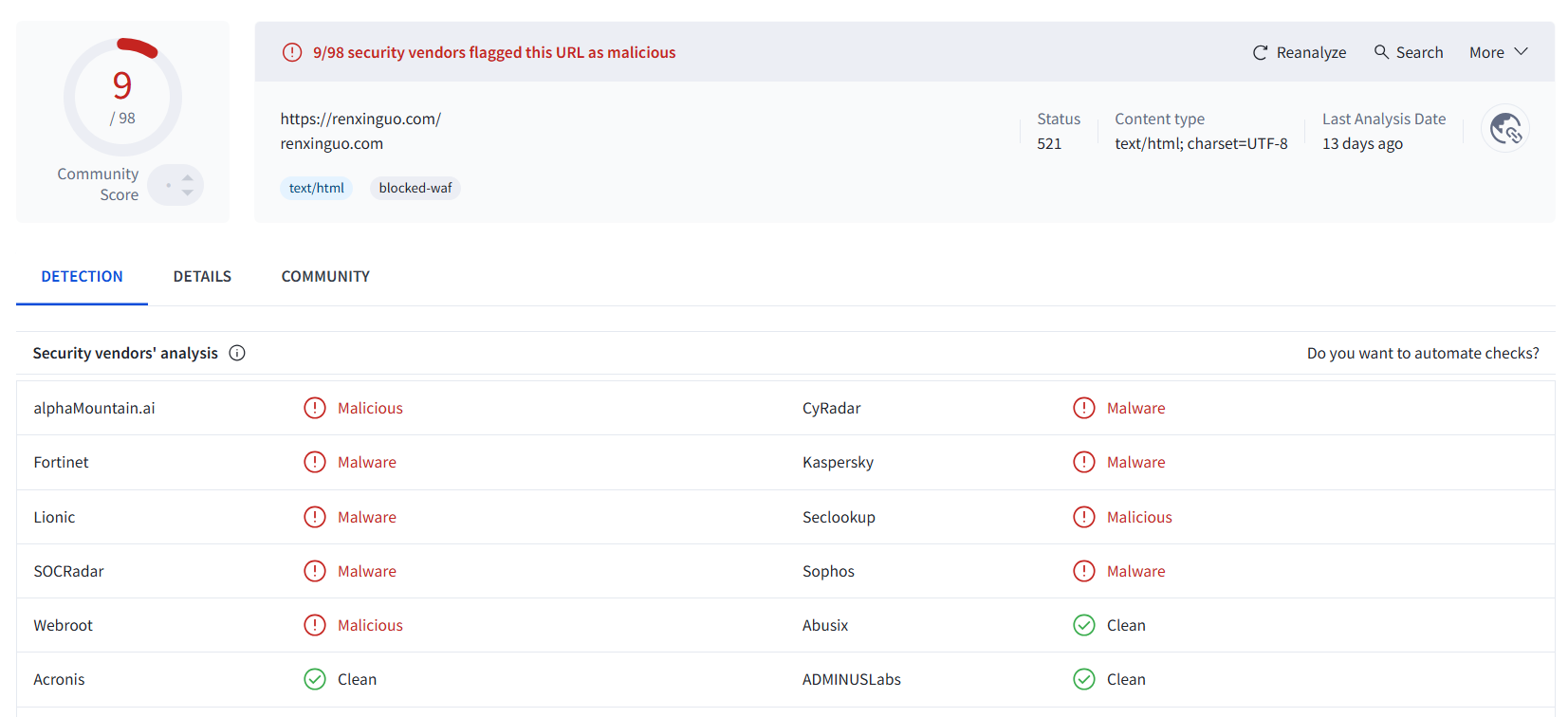
Associated IP 172.67.136.169 belongs to ASN 13335 (CLOUDFLARENET, US), providing proxy services. The domain is geolocated to Ascension Island. Threat actors commonly leverage Cloudflare infrastructure to mask C2 traffic and evade detection.
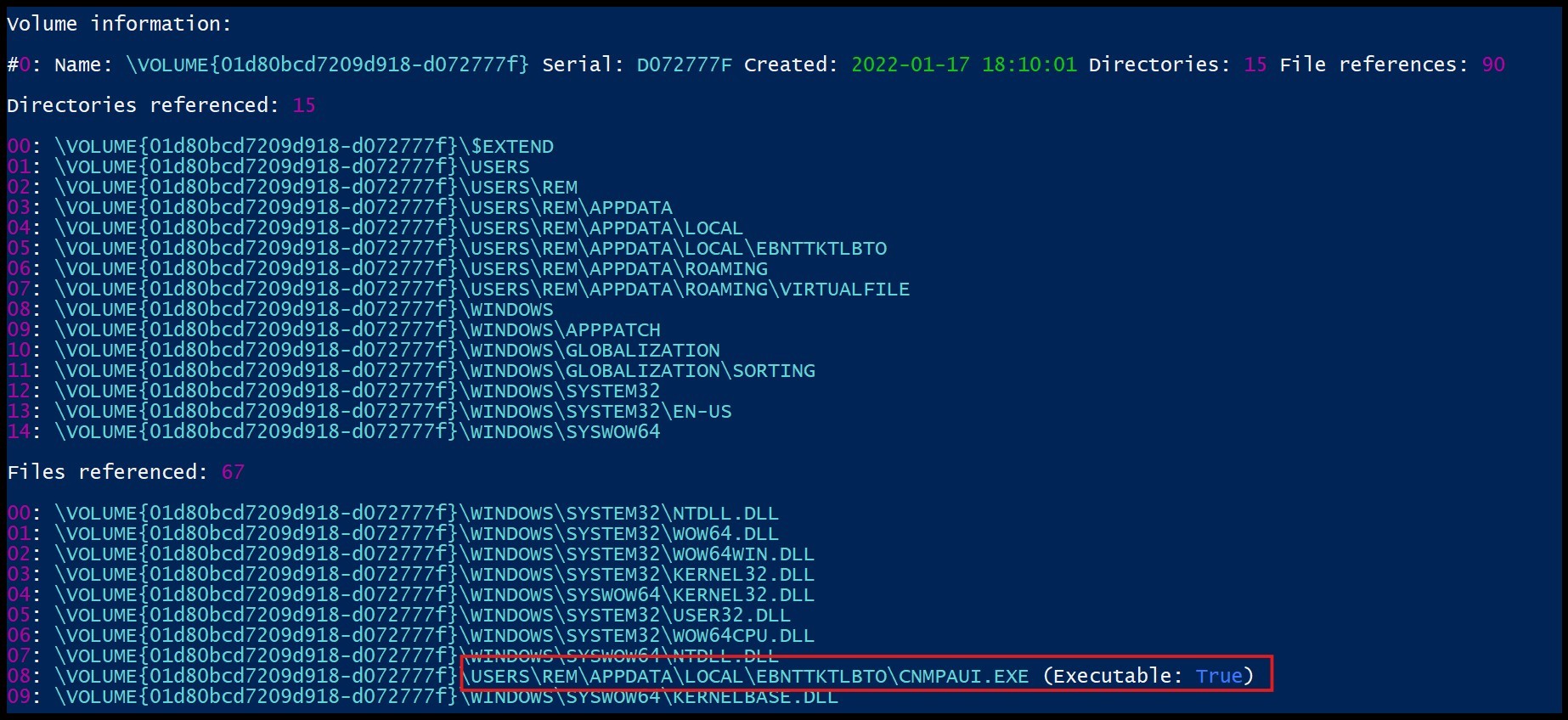
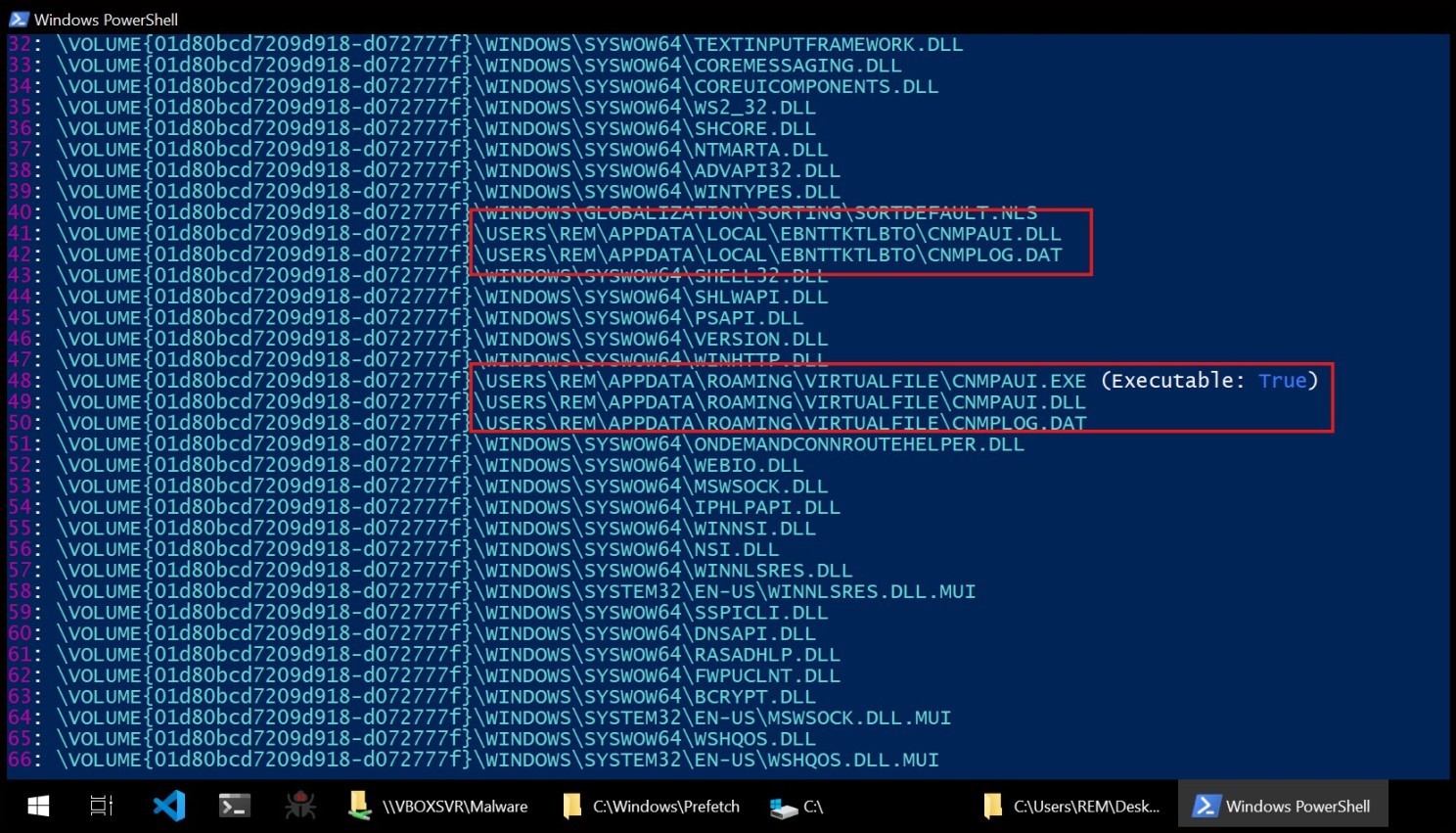
Prefetch and MFT Forensic Evidence
Prefetch Analysis
Multiple entries indicate repeated executions across different time periods. This validates persistence mechanism functionality.
MFT Timeline (Confirmed File Locations)
Master File Table analysis shows complete file system operations:
\Users[USER]\AppData\Local\EbNTtKIlBtO\
\Users[USER]\AppData\Roaming\VirtualFile\
\Users[USER]\Intelnet\
\ProgramData\VirtualFile\

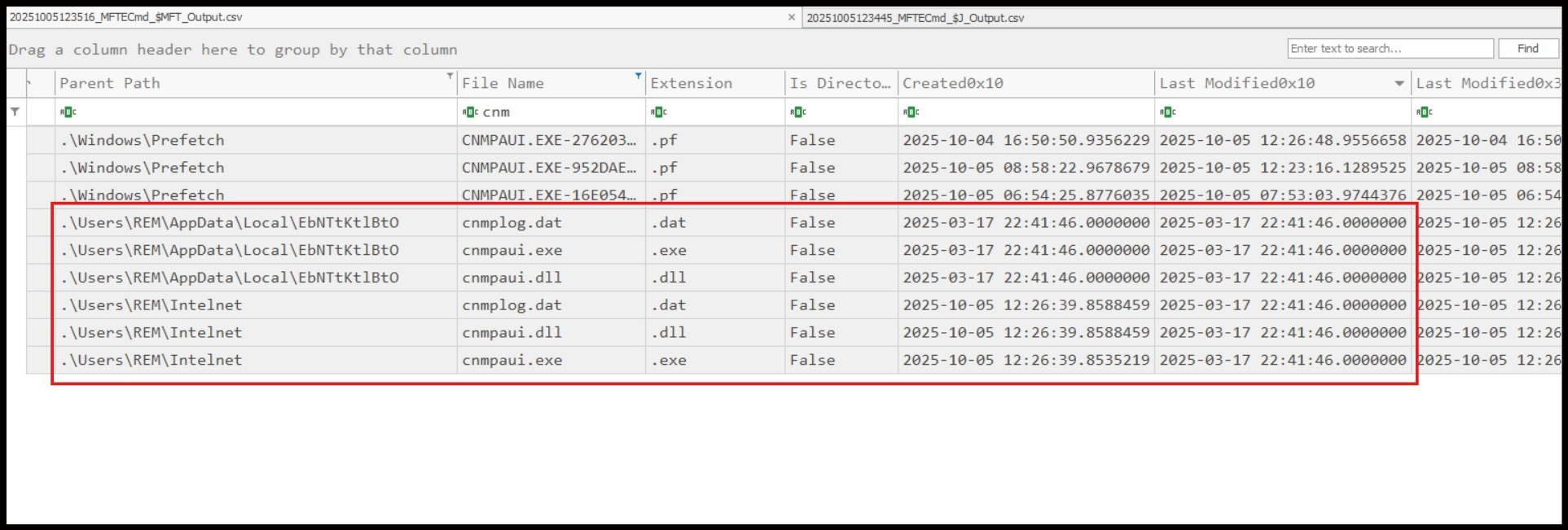
FileCreate, DataOverwrite, DataExtend, and BasicInfoChange operations were logged. This provides forensic evidence of active malicious functionality
Memory Forensic Analysis
Process Tree In Memory
msiexec.exe spawning the cnmpaui.exe which consistent with MSI abuse / LOLBAS installation. msiexec.exe launching an EXE from %LOCALAPPDATA%\... is abnormal and commonly used to stage payloads without writing to Program Files.

DLL Side-Loading via Canon IJ Printer Assistant Tool In Memory
A legitimate, signed Canon executable (CNMPAUI.EXE) was launched from a user-writable staging folder and immediately loaded an unsigned companion DLL (cnmpaui.dll) from the same directory as a classic DLL side-loading pattern.
Mutex Artifact Identified During Memory Analysis
Memory forensic analysis using Volatility identified a mutex object named rSGzGKyej, indicating potential malware synchronization or process coordination behavior. Such mutex values are commonly used by malware to prevent multiple instances from running simultaneously and to mark infection presence on the system.
Registry Artifacts in Memory
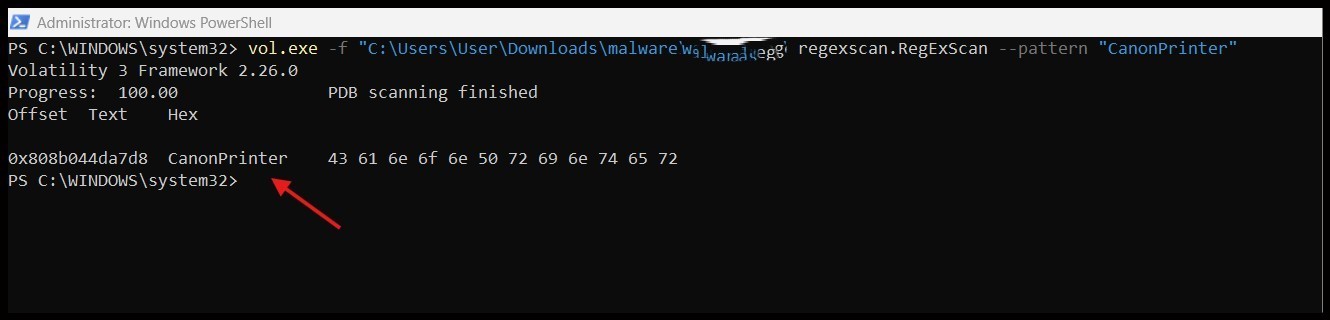
Registry pattern scanning identified persistence artifacts in memory:
Offset: 0x808b044da7d8
Text: CanonPrinter
Hex: 43 61 6e 6f 6e 50 72 69 6e 74 65 72
The registry value name persists in process memory. This corroborates live registry analysis and validates persistence mechanism findings.
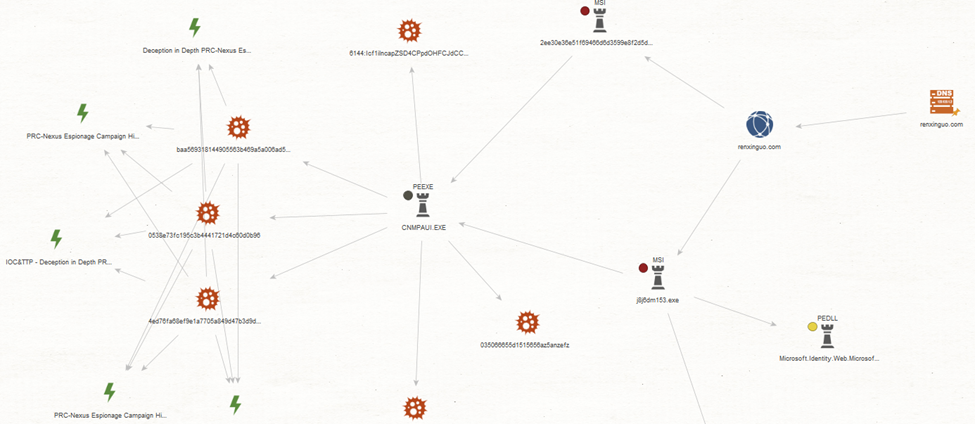
Pivoting
Additionally, we identified files such as cnmpaui.dll and cnmplog.dat with distinct hashes associated with renxinguo[.]com, suggesting the presence of variant samples or recompiled iterations leveraging the same C2 infrastructure. The identified hash values are as follows:
cnmpaui.dll -fd65d192f2425916585450e46c9cc1db7747d00d1614a8ef835940f06795e2b4
cnmpaui.dat -55e0e9167fa3612135815ed01119a91281373c08c257efc8f7cc36bcc08734d2
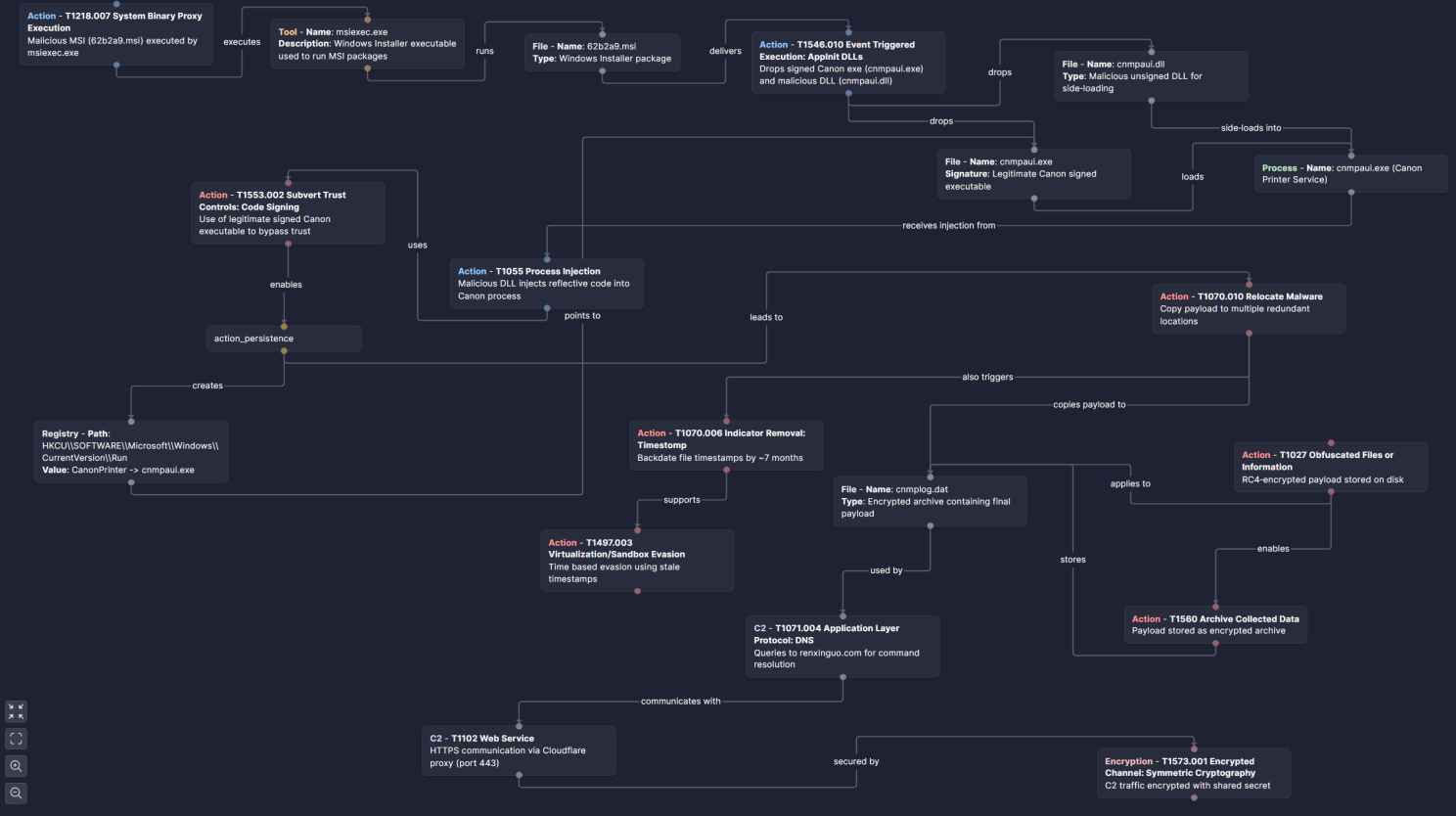
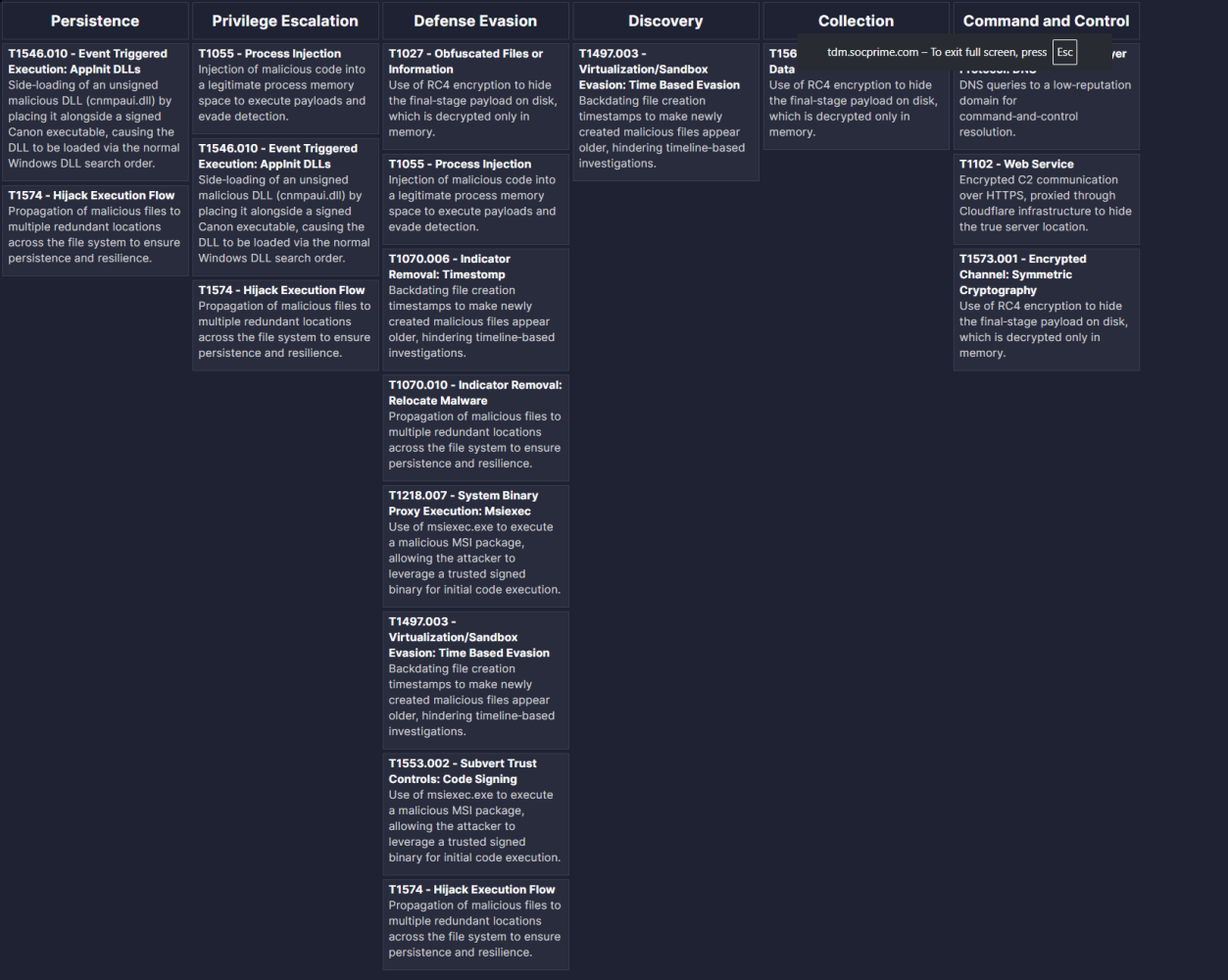
MITRE ATT&CK Mapping
Indicators of Compromise
File Hashes
9023a0c8a43282ff42abb917bc7e3163b421296d23c47ff2a0275425ea1caf40 (62b2a9.msi)
4ed76fa68ef9e1a7705a849d47b3d9dcdf969e332bd5bcb68138579c288a16d3 (cnmpaui.exe)
f7012e1ae246646fa8e87511272f0e9931227e8b7a5f186efb9a6c77913a00e0 cnmpaui.dll (CANONSTAGER/PlugX)
cc4db3d8049043fa62326d0b3341960f9a0cf9b54c2fbbdffdbd8761d99add79 cnmplog.dat (Encrypted Payload)
Network Indicators
Domain: renxinguo[.]com
Cloudflare IP: 172.67.136.169
File Paths
\Users\[USER]\AppData\Local\EbNTtKIlBtO\
\Users\[USER]\AppData\Roaming\VirtualFile\
\Users\[USER]\Intelnet\
\ProgramData\VirtualFile\
Registry Keys
HKCU\SOFTWARE\Microsoft\Windows\CurrentVersion\Run
Value: CanonPrinter
Mutex
rSGzGKyej
Detection Engineering
Boot or Logon Autostart Execution: Registry Run Keys / Startup Folder - T1547.001
DeviceRegistryEvents
| where ActionType == "RegistryValueSet"
| where RegistryKey contains
@"\Software\Microsoft\Windows\CurrentVersion\Run"
| where RegistryValueName contains "CanonPrinter"
| where RegistryValueData contains @" \cnmpaui.exe"
User Execution: Malicious File - T1204.002
DeviceFileEvents
| where ActionType == "FileCreated"
| where FolderPath has_any (
@"\AppData\Local\EbNTtKIlBtO\",
@"\AppData\Roaming\VirtualFile\",
@"\Intelnet\",
@"\ProgramData\VirtualFile\"
)
| where FileName has_any ("cnmpaui.exe", "cnmpaui.dll",
"cnmplog.dat")
Mitigation
# Kill malicious processes
Get-Process | Where-Object { $_.ProcessName -eq "cnmpaui"
-or $_.Path -like "*cnmpaui.exe*" } | Stop-Process -Force
# Remove registry persistence
Remove-ItemProperty -Path
"HKCU:\Software\Microsoft\Windows\CurrentVersion\Run" -
Name "CanonPrinter" -ErrorAction SilentlyContinue
# Delete all malicious directories
Remove-Item -Path "$env:LOCALAPPDATA\EbNTtKIlBtO" -Recurse
-Force -ErrorAction SilentlyContinue
Remove-Item -Path "$env:APPDATA\VirtualFile" -Recurse -
Force -ErrorAction SilentlyContinue
Remove-Item -Path "$env:USERPROFILE\Intelnet" -Recurse -
Force -ErrorAction SilentlyContinue
Remove-Item -Path "C:\ProgramData\VirtualFile" -Recurse -
Force -ErrorAction SilentlyContinue
# Block DNS resolution
Add-Content -Path "C:\Windows\System32\drivers\etc\hosts"
-Value "`n0.0.0.0 renxinguo.com" -ErrorAction
SilentlyContinue
Conclusion
This UNC6384 campaign demonstrates continued evolution of PRC-nexus cyber espionage operations. The combination of MSI abuse with DLL side-loading leverages legitimate software trust while deploying sophisticated malware. Multi-stage deployment, extensive anti-forensics, and redundant persistence indicate mature operational security.
The abuse of Canon printer software through DLL hijacking represents concerning evolution in defense evasion. Exploiting code signing trust and software brand recognition makes detection significantly harder. PlugX/Korplug continues demonstrating operational effectiveness across a decade of Chinese state-sponsored campaigns.
Research By PHYO PAING HTUN, KYAW PYIYT HTET